

Spotify Technology S.A. stocks have been trading up by 6.59 percent following upbeat subscriber growth and profitability outlook.
What Traders Need To Know
- Q3 2026 results underscored Spotify Technology S.A.’s global scale, with 788 million monthly users and 306 million subscribers, plus a planned Q&A with co-CEOs and the CFO.
- Q4 guidance calls for 818 million monthly users, 316 million premium subs, and 33.8% gross margin, pairing growth with improving profitability.
- Recent results showed 16% revenue growth year over year, 6 million net new premium subs, and guided Q4 revenue of €5.2B, sending shares higher despite a small EPS miss.
- Multiple major banks lifted SPOT price targets into roughly the $650–$725 band while keeping Buy/Outperform/Overweight ratings, signaling strong confidence in margin expansion.
- A new AI-powered remix and cover tool, backed by a licensing deal with Believe, aims to add a $4–$5 monthly upsell around early 2027, with royalties and artist consent built in.
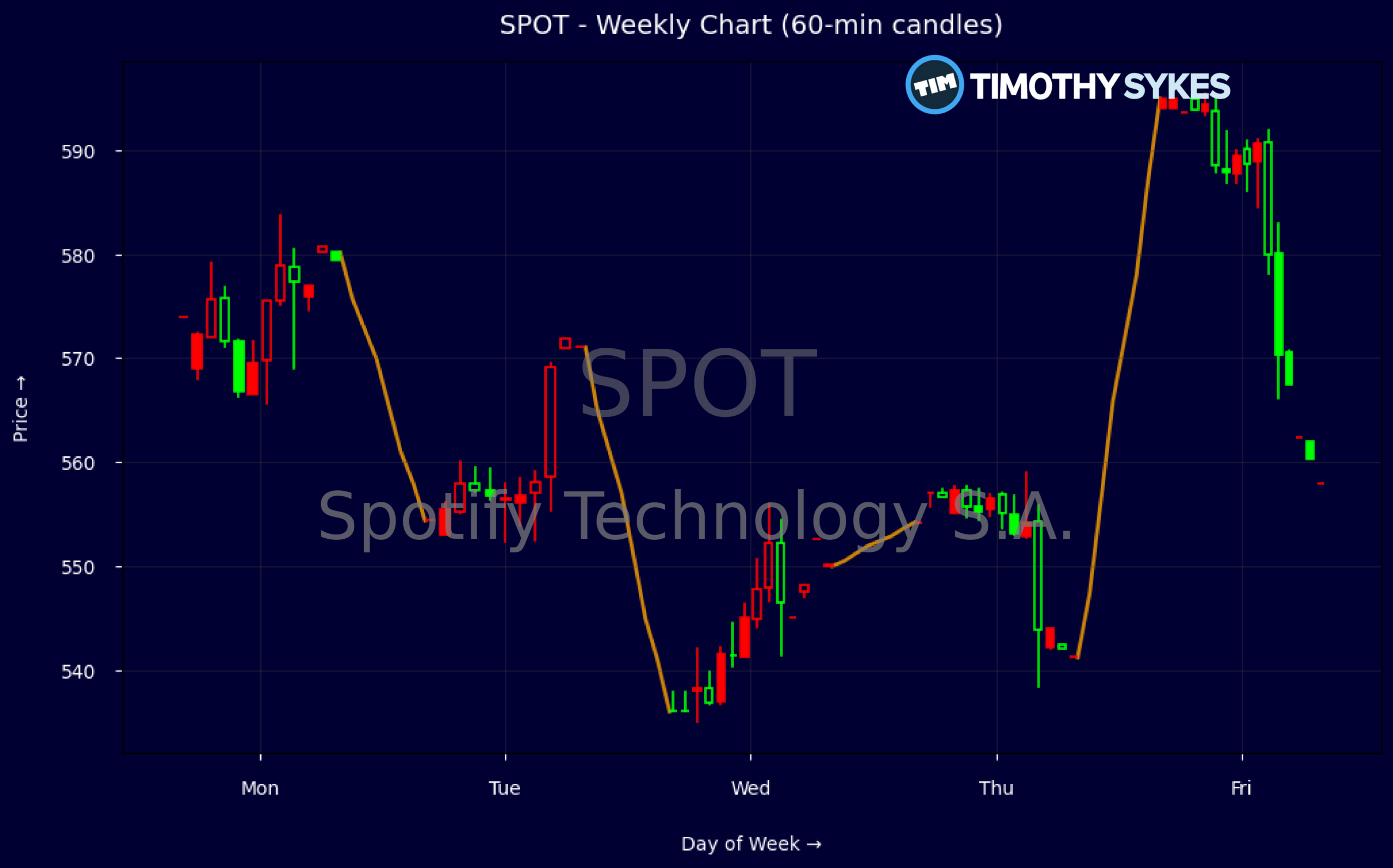
Weekly Update Oct 26 – Oct 30, 2026: On Sunday, November 01, 2026 Spotify Technology S.A. stock [NYSE: SPOT] is trending up by 6.59%! Discover the key drivers behind this movement as well as our expert analysis in the detailed breakdown below.
Media & Telecommunications industry expert:
Analyst sentiment – positive
Spotify holds a dominant global audio position with 788m MAUs and 306m subs, monetized into ~$17.2bn revenue and a rich 5.46x sales and 11.3x book valuation, well above Media & Telco peers. Balance sheet quality is strong: €9.5bn cash versus €0.6bn long-term liabilities, leverageratio 1.8, long-term debt/capital only 5%. ROIC at 33.6% versus still-negative ROA and ROE indicates an inflection from scale-first to returns-focused, supporting a durable margin-upgrade story.
Technically, SPOT is in a strong, accelerating uptrend: last week’s range lifted from a 536 low to a 594 close, with buyers consistently defending higher lows after each brief pullback. Intraday 5‑minute action shows repeated dip-buying near the mid‑$550s on rising volume. The key actionable level is $555: above it, momentum buyers should target $620; a decisive break below $555 on heavy volume would signal a short-term reversal toward $530 support.
Fundamentally and versus Interactive Media peers, Spotify is now a profitable, cash-rich scaled platform, justifying premium multiples as it transitions into a margin “harvesting” phase. Street targets cluster $630–$725 with fresh upward revisions, underpinned by Q4 guidance for 33.8% gross margin and continued MAU/sub growth, plus optionality from AI remix products and improved label leverage. I set a 12‑18 month target of $680, with strong support at $530 and resistance near $650–$675.
More Breaking News
Quick Financial Overview
Spotify Technology S.A. sits at an interesting crossroads: rapid user growth, improving margins, and a stock that has already reacted sharply to the story. The company reported 788 million monthly active users and 306 million premium subscribers in Q3 2026, and is guiding Q4 users to 818 million and premium subs to 316 million. For traders, that kind of scale means even small changes in pricing or add-ons can move the revenue line meaningfully.
From a fundamentals snapshot, SPOT’s trailing revenue is about $17,186.0M, translating to revenue per share of roughly $81.55. A price-to-sales ratio near 5.46 and price-to-book around 11.27 tell you the market is paying up for growth and brand strength rather than current profits. On the balance sheet side, total assets sit near $15,015.0M with cash and short-term investments close to $9,467.0M, and leverage is moderate with a ratio around 1.8 and long-term debt relatively low versus equity.
On the tape, SPOT has been volatile but strong. Recent daily closes ranged roughly from the mid-$530s to just under $595, with one session closing around $593.98 after pushing to the mid-$590s intraday. A 5‑minute candle showing a move from about $575 to a close near $593.44 in the same session signals aggressive dip-buying and strong momentum. With Barclays noting the stock up over 8% in a single day around $568.60 after guidance, traders are dealing with a momentum name that can move fast both ways.
Conclusion
Spotify Technology S.A. is trading like a high‑conviction growth story where execution is finally lining up with the long‑term narrative. Q3 2026 showed 16% year-over-year revenue growth and 6 million net new premium subscribers, while management guided Q4 revenue to about €5.2B with accelerating growth and a 33.8% gross margin. Pair that with guidance for 818 million monthly users and 316 million premium subs, and you have a platform that is still adding scale while tightening its unit economics.
Wall Street is responding in kind. Oppenheimer, Wells Fargo, JPMorgan, Guggenheim, Bernstein, Morgan Stanley, Barclays, and Deutsche Bank all pushed price targets higher into roughly the $650–$725 zone, keeping Buy, Outperform, or Overweight labels on SPOT. The consensus is that margin expansion, operating expense discipline, and new AI‑driven products justify richer multiples. At the same time, one firm trimming its rating to Accumulate while lifting its target to $650 is a reminder that valuation risk is real after a big run.
For traders, the setup in SPOT revolves around riding momentum while respecting how crowded the bullish trade has become. The AI remix tool and other add‑ons could lift average revenue per user over time, but they also introduce execution and licensing risk that the market will quickly price in if anything slips. As millionaire penny stock trader and teacher Tim Sykes says, “Small gains add up over time; focus on building wealth gradually, not chasing jackpots.” That mindset applies here: the edge is in managing risk trade by trade rather than swinging for home runs just because a chart looks strong. As I tell my students, “The edge isn’t in believing the story, it’s in trading the levels the story creates and walking away fast when the tape stops agreeing with you.”
This is stock news, not investment advice. Timothy Sykes News delivers real-time stock market news focused on key catalysts driving short-term price movements. Our content is tailored for active traders and investors seeking to capitalize on rapid price fluctuations, particularly in volatile sectors like penny stocks. Readers come to us for detailed coverage on earnings reports, mergers, FDA approvals, new contracts, and unusual trading volumes that can trigger significant short-term price action. Some users utilize our news to explain sudden stock movements, while others rely on it for diligent research into potential investment opportunities.
Dive deeper into the world of trading with Timothy Sykes, renowned for his expertise in penny stocks. Explore his top picks and discover the strategies that have propelled him to success with these articles:
- Penny Stocks Trading Guide
- Best Penny Stocks Under $1 to Buy Today
- Top 8 Penny Stocks to Watch on Robinhood
Once you’ve got some stocks on watch, elevate your trading game with StocksToTrade the ultimate platform for traders. With specialized tools for swing and day trading, StocksToTrade will guide you through the market’s twists and turns.
Dig into StocksToTrade’s watchlists here:




Leave a reply