

Wingstop Inc. stocks have been trading up by 12.82 percent following upbeat growth headlines and strong analyst upgrades.
Key Takeaways For WING Traders
- Fiscal Q3 adjusted EPS came in at $1.08 versus $1.02 expected, while revenue of $185.1M missed the $192.9M consensus.
- Domestic same-store sales fell 5.4% year over year in Q3 2026, pushing management to reset expectations and lean on Club Wingstop, marketing, and better operations to revive growth.
- Management pointed to a pipeline of 2,300+ committed restaurants and a goal of 10,000+ global locations, including a 1,000-unit India opportunity expected to start opening in early 2027.
- Despite lowering its outlook on softer same-store sales, WING jumped about 12% intraday after earnings, signaling traders were braced for worse.
- RBC lifted its WING price target to $175, while Citi, Morgan Stanley, StoneX, Baird, Mizuho, and UBS all tweaked targets but mostly kept positive ratings, with a Street mean target near $187.38.
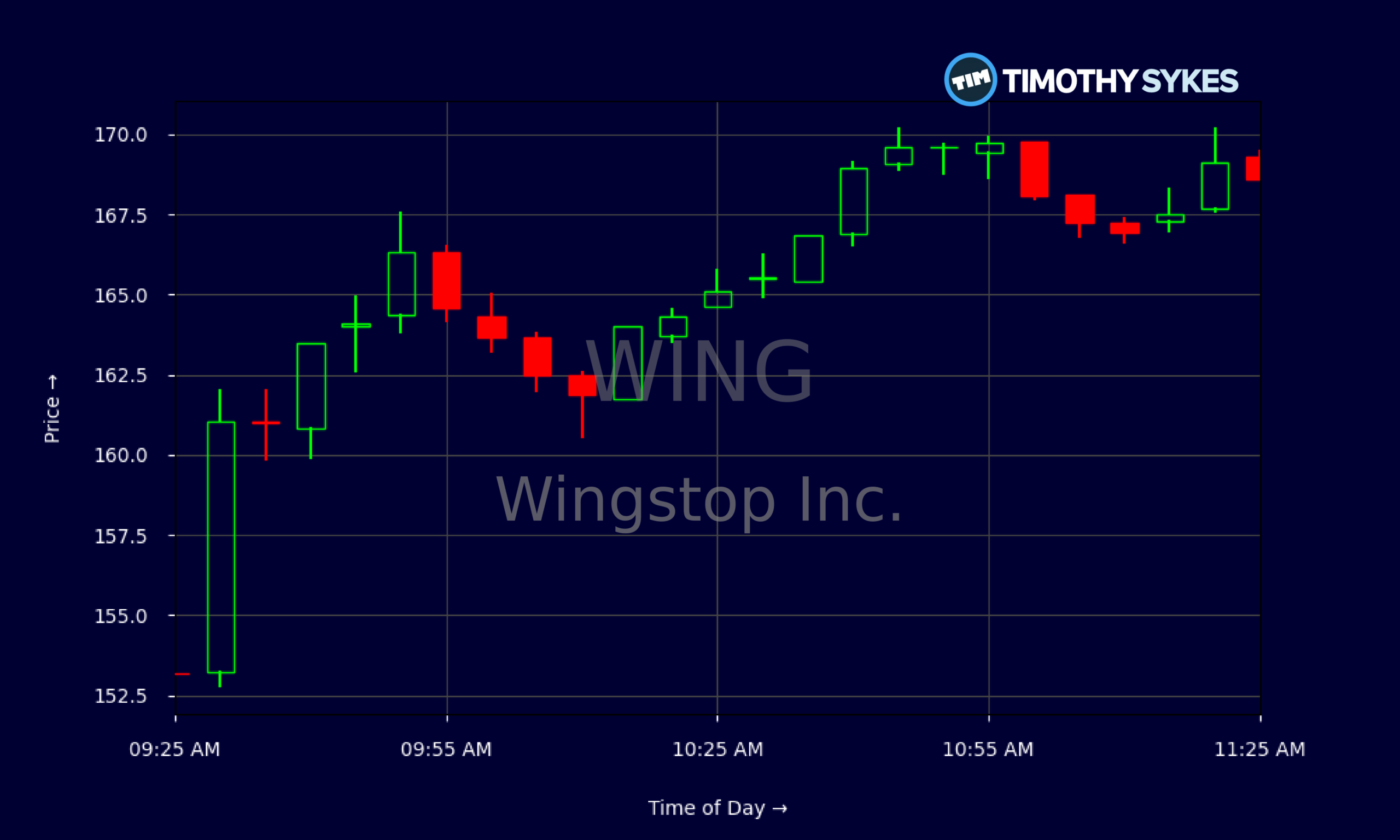
Live Update At 11:32:35 EST: On Monday, November 02, 2026 Wingstop Inc. stock [NASDAQ: WING] is trending up by 12.82%! Discover the key drivers behind this movement as well as our expert analysis in the detailed breakdown below.
Quick Financial Overview
Wingstop Inc. just put up one of those quarters that keeps traders glued to the Level 2. On the surface, WING delivered adjusted Q3 EPS of $1.08, ahead of the $1.02 Wall Street expected, even as revenue climbed to $185.1M but landed below the $192.9M consensus. So earnings execution was solid, revenue quality less so.
On the tape, WING has gone from a base around the low $120s in mid-2026/10 to a recent close near $168.93 on 2026/11/02. That is a powerful trend leg, especially with a post-earnings gap from roughly $153 at the open to over $160 within the first half hour of trading. Intraday, WING pushed as high as $170.17 before cooling just under $169, showing strong dip buying all morning.
More Breaking News
Fundamentally, Wingstop’s model is high margin and asset light. Gross margin sits near 76.8%, EBIT margin around 27.8%, and net margin just above 16%. Return on assets is above 17%, backed by a current ratio near 3, giving WING healthy liquidity. The flip side is a rich valuation: a P/E around 28.8 and price-to-sales near 4.6 keep WING squarely in “growth stock” territory. For traders, that combo—strong margins plus a premium multiple—means the market still expects Wingstop to keep compounding, and any stumble in same-store sales will hit the chart fast.
Why Traders Are Watching WING After This Earnings Reset
The latest Wingstop earnings were all about a reset, not a breakdown. WING admitted a problem where it hurts: domestic same-store sales dropped 5.4% versus Q3 2025, and management lowered its outlook. Normally, that kind of comp slide is gasoline for a selloff. Instead, WING ripped roughly 12% intraday after the 2026/10/28 print.
Why? A lot of the bad news was already baked into the price. Traders had been leaning cautious into the report, so when Wingstop showed EPS strength and a clear game plan, shorts scrambled and momentum traders piled in. The company laid out a focused playbook: ramp up Club Wingstop, sharpen marketing, and tighten store-level operations to pull traffic back. Early signals from the loyalty program were strong enough that RBC not only reiterated its Outperform view but raised its WING target from $150 to $175.
At the same time, the long-term story stayed intact. On the Q3 call, Wingstop highlighted more than 2,300 committed restaurants in its development pipeline, with international units up 27% year over year to 544. Management talked openly about a path to 10,000+ global locations and sized India alone as a potential 1,000-restaurant market starting in early 2027. That is the kind of unit growth runway momentum traders like to hear.
Sell-side action backed that narrative. Mizuho, StoneX, Citi, Morgan Stanley, and Baird all nudged WING price targets down—often by just a few dollars—while keeping Buy, Outperform, or Overweight calls. UBS lifted its target from $140 to $150 but stayed Neutral, even as WING traded near $141.34 and the Street’s mean target hovered around $187.38. Net message to traders: expectations have been trimmed, but most analysts still treat Wingstop as a core growth name rather than dead money.
Conclusion
For active traders, WING now trades like a classic “high expectations, fresh reset” story. The chart shows that shift clearly: days of grinding in the $120s and $130s flipped into a post-earnings breakout toward $170 after Wingstop reset comps, trimmed guidance, yet proved it can still beat on EPS. The market is signaling that earnings quality, margin strength, and the global pipeline outweigh near-term comp weakness—for now.
But this is not a free ride. A P/E near 29 and a rich price-to-cash-flow multiple mean Wingstop has very little room for another misstep on same-store sales. If the Club Wingstop push and new marketing do not move the needle, WING’s premium can compress quickly. That’s exactly why short-term traders should watch upcoming monthly and quarterly updates like hawks.
Wingstop’s 10,000-restaurant ambition, the 2,300-unit pipeline, and the India expansion plan give WING a long runway that many restaurant chains would love to have. The key for traders is to respect both sides of the setup: powerful upside if comps stabilize, real risk if they don’t. As millionaire penny stock trader and teacher Tim Sykes says, “Cut losses quickly, let profits ride, and don’t overtrade.”. As Tim Sykes loves to remind his students, “The market rewards preparation, not hope.” With WING, that means studying the chart, tracking each fundamental data point, and being ready to cut losses fast if the story breaks.
This is stock news, not investment advice. Timothy Sykes News delivers real-time stock market news focused on key catalysts driving short-term price movements. Our content is tailored for active traders and investors seeking to capitalize on rapid price fluctuations, particularly in volatile sectors like penny stocks. Readers come to us for detailed coverage on earnings reports, mergers, FDA approvals, new contracts, and unusual trading volumes that can trigger significant short-term price action. Some users utilize our news to explain sudden stock movements, while others rely on it for diligent research into potential investment opportunities.
Dive deeper into the world of trading with Timothy Sykes, renowned for his expertise in penny stocks. Explore his top picks and discover the strategies that have propelled him to success with these articles:
- Penny Stocks Trading Guide
- Best Penny Stocks Under $1 to Buy Today
- Top 8 Penny Stocks to Watch on Robinhood
Once you’ve got some stocks on watch, elevate your trading game with StocksToTrade the ultimate platform for traders. With specialized tools for swing and day trading, StocksToTrade will guide you through the market’s twists and turns.
Dig into StocksToTrade’s watchlists here:





Leave a reply