

Range Resources Corporation stocks have been trading up by 4.35 percent amid bullish sentiment on strengthened natural gas price outlook.
What Traders Need To Know
- UBS highlights that Range Resources faces weak daily gas prices but has not cut production, with stronger NGL and export pricing expected to support cash flow into year-end and a flexible path to 2.7 Bcfe/d by 2027.
- UBS trimmed its RRC price target to $44 from $49 with a Neutral view, while the broader Hold consensus centers near $46, modestly above recent pricing around the high-$30s.
- Mizuho cut its Range Resources Corporation target to $52 but kept an Outperform rating, and Morgan Stanley nudged its target up to $45 with Equal Weight, tying focus to 2027 plans into the Q3 call.
- Scotiabank launched coverage on RRC at Sector Perform with a $42 target, reinforcing a neutral Street stance rather than a high-conviction bull or bear call.
- WhiteHawk’s royalty acquisition across Marcellus, Utica, and Haynesville increases exposure to acreage operated by Range Resources and peers, signaling continued third-party capital backing for these core gas basins.
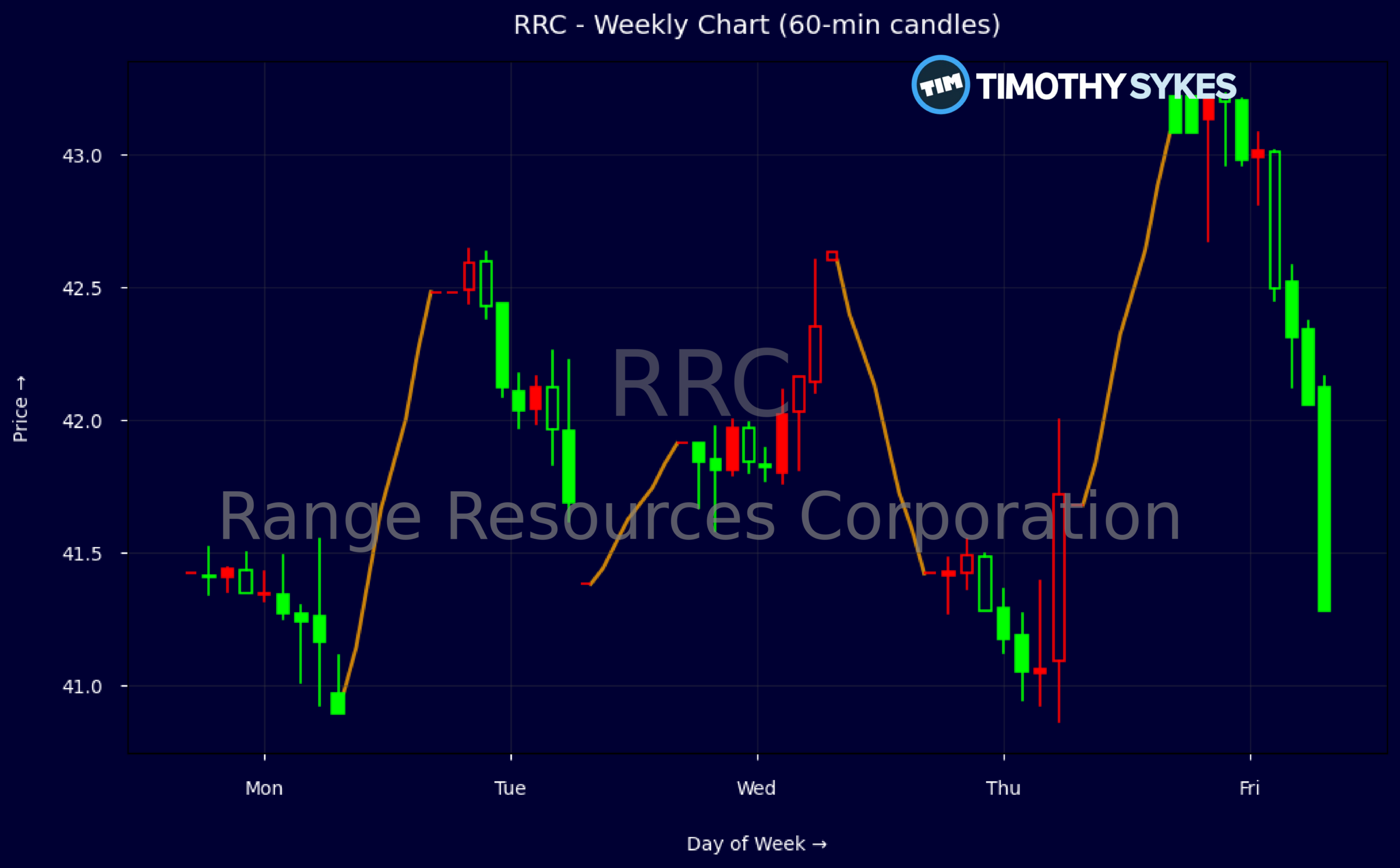
Weekly Update Oct 12 – Oct 16, 2026: On Saturday, October 17, 2026 Range Resources Corporation stock [NYSE: RRC] is trending up by 4.35%! Discover the key drivers behind this movement as well as our expert analysis in the detailed breakdown below.
Energy industry expert:
Analyst sentiment – positive
Range Resources holds a strong competitive position in Appalachia with top-quartile profitability: EBIT margin 35% and EBITDA margin 47% on ~$3.0B revenue, and ROE near 20% with low leverage (D/E 0.11, interest coverage ~19x). Asset turnover of 0.5 and mid‑20s net margins confirm efficient capital deployment. The balance sheet is robust despite negative working capital, as debt is long-dated and manageable. Valuation at ~11x earnings and ~10x cash flow is reasonable versus gas‑weighted peers.
Technically, RRC is in a clear short-term uptrend, moving from ~$41 to $43.22 over the week, with repeated support buyers near $41.40 and higher highs on strong intraday volume into the close. Recent 5‑minute candles show persistent bid absorption above $42.70. Dominant trend is bullish above $41.50. A specific actionable level is $42.00–42.20: pullbacks into this zone are buyable with a stop below $41.40, targeting a push through $44 near term.
Near-term catalysts are winter gas and NGL pricing, Q3 results, and updated 2027 production plans. Street sentiment is firmly neutral but constructive: multiple price targets cluster in the low‑to‑mid $40s with UBS and others highlighting resilient volumes, improving NGL fundamentals, and capacity to grow shareholder returns as debt falls. Versus broader Energy and Fossil Fuels benchmarks, RRC offers superior gas torque and cleaner balance sheet. Base case: accumulate with upside toward $46–48, support ~$40, resistance $45–46.
More Breaking News
Quick Financial Overview
Range Resources Corporation is trading in the low-$40s, with recent weekly closes between about $41 and $43, showing a steady grind higher into mid-October 2026. The weekly high near $43.22 lines up with the intraday 5-minute candle, where price pushed from roughly $41.28 to $43.22 in a single strong session. For short-term traders, that move shows decisive buying interest on dips around $41 and emerging resistance near the low-$43 area.
On the fundamentals, RRC printed roughly $2.99B in trailing revenue with a price-to-sales near 2.86 and a P/E around 11.3, which is not stretched for a profitable gas producer. Margins are robust for a commodity name, with EBIT margin above 35% and EBITDA margin close to 47%, backed by strong asset efficiency and return on equity above 19%. Cash flow per share near $5.82 and book value per share around $20.15 leave the stock trading at a little over 2x book and about 10x cash flow.
Financial strength looks solid: total debt-to-equity sits near 0.11 and interest coverage is close to 19x, even though the current and quick ratios under 1 remind traders that this is still a capital-intensive business. Recent quarterly numbers show about $235M in operating cash flow and roughly $54M in free cash flow after around $181M in capital spending. RRC is also returning cash via a modest dividend of $0.40 per year, under a 1% yield, while continuing to manage long-term debt. Overall, the balance sheet and profitability metrics give Range Resources Corporation room to navigate volatile gas prices.
Conclusion
This is stock news, not investment advice. Timothy Sykes News delivers real-time stock market news focused on key catalysts driving short-term price movements. Our content is tailored for active traders and investors seeking to capitalize on rapid price fluctuations, particularly in volatile sectors like penny stocks. Readers come to us for detailed coverage on earnings reports, mergers, FDA approvals, new contracts, and unusual trading volumes that can trigger significant short-term price action. Some users utilize our news to explain sudden stock movements, while others rely on it for diligent research into potential investment opportunities.
Dive deeper into the world of trading with Timothy Sykes, renowned for his expertise in penny stocks. Explore his top picks and discover the strategies that have propelled him to success with these articles:
- Penny Stocks Trading Guide
- Best Penny Stocks Under $1 to Buy Today
- Top 8 Penny Stocks to Watch on Robinhood
Once you’ve got some stocks on watch, elevate your trading game with StocksToTrade the ultimate platform for traders. With specialized tools for swing and day trading, StocksToTrade will guide you through the market’s twists and turns.
Dig into StocksToTrade’s watchlists here:





Leave a reply