

Comcast Corporation Common Stock surged as investors cheered its most impactful earnings beat, and stocks have been trading up by 4.4 percent.
What Traders Need To Know
- Q3 results topped expectations on both EPS and revenue, with CMCSA showing strong free cash flow and profitable streaming and film units.
- Management flagged a Q4 restructuring charge above $1B as Comcast simplifies its structure ahead of the NBCUniversal and Sky separation.
- Planned job cuts and reorganization across cable, broadband, and wireless mark a major shift toward a focused connectivity business by 2027.
- Multiple banks trimmed CMCSA price targets but kept positive or neutral ratings, reflecting mixed but stable sentiment during the transition.
- Ongoing broadband build-outs and a $0.33 quarterly dividend payable 2027/01/27 support a steady, cash-generating profile through the shake-up.
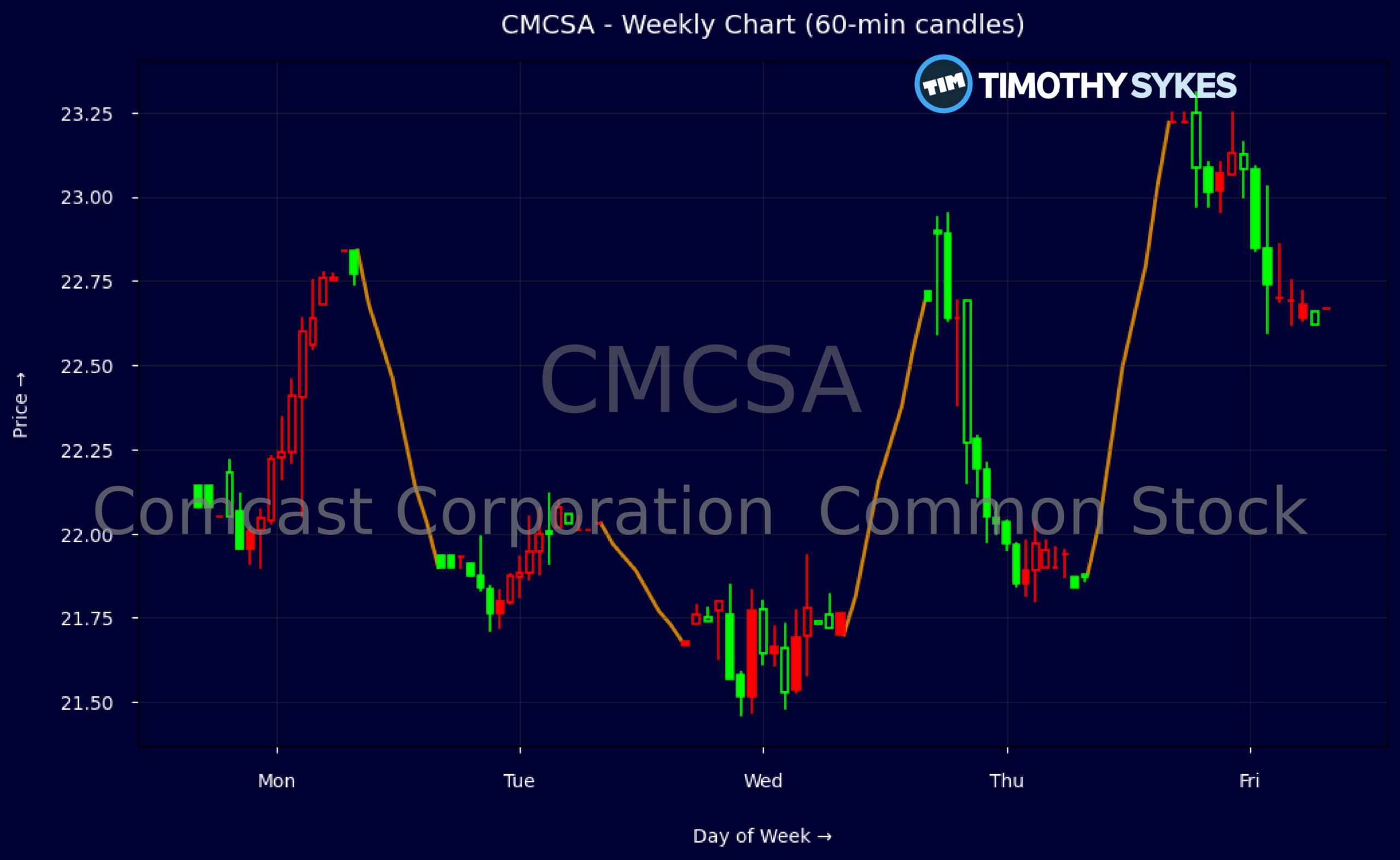
Weekly Update Oct 26 – Oct 30, 2026: On Friday, October 30, 2026 Comcast Corporation Common Stock stock [NASDAQ: CMCSA] is trending up by 4.4%! Discover the key drivers behind this movement as well as our expert analysis in the detailed breakdown below.
Media & Telecommunications industry expert:
Analyst sentiment – positive
Comcast sits in a dominant, cash‑generative position across U.S. broadband and global media, but the market is pricing it as a distressed value name. Revenue of ~$124B with mid‑teens EBIT margin and ~27% EBITDA margin supports robust Q3 free cash flow of $4.2B. A P/E of 6.6x and ~0.6x sales, alongside 2.3x price‑to‑cash flow and 0.8x book, are deeply discounted versus large-cap cable and media peers (typically 8–12x earnings). Leverage is elevated but manageable at ~2.9x and 1.0x debt/equity, backed by strong interest cover (~7.8x) and high‑teens ROE.
Technically, CMCSA has shifted from short‑term weakness back to a nascent uptrend. The weekly tape shows a rebound from sub‑$22 lows to a $23.22 close, with higher highs/lows across the week and buyers absorbing supply near $22. The 5‑minute action post‑earnings showed expanding volume on up‑candles, confirming accumulation rather than a one‑day squeeze. For trading, $22.00 is the key pivot: above it, risk‑reward favors longs targeting $24.50, with stops just below $21.50.
Near‑term news skew is positive versus a peer group still wrestling with cord‑cutting and weak ad markets. Comcast beat Q3 EPS and revenue, generated strong FCF, and delivered a second profitable quarter at Peacock plus record Universal box office, offsetting connectivity softness. Aggressive broadband build‑outs and Universal Ads’ CTV integrations reinforce long‑term competitiveness. The 2027 NBCU/Sky separation and >$1B restructuring charge add execution risk but also unlock valuation. Relative to media and telco benchmarks, CMCSA deserves at least 8x forward EPS, implying a 12‑month fair value of $27–28, with strong support at $21 and resistance at $25.
More Breaking News
Quick Financial Overview
CMCSA, the ticker for Comcast Corporation Common Stock, is trading in a tight but constructive band. Weekly data show the stock grinding from the low $22s toward $23.22, with higher closes late in the week hinting at steady dip buying. Intraday, CMCSA spent most of the session between $22.90 and $23.20, with a controlled push into the close at $23.22, signaling accumulation rather than panic. This kind of slow, orderly tape often appears when institutions are building positions around a perceived value zone.
Fundamentally, Comcast Corporation Common Stock is throwing off solid cash. Q3 revenue came in at $29.3B, beating expectations, with adjusted EPS at $1.07 versus $0.99 consensus. Margins are healthy for a mature telecom-media hybrid: EBITDA margin sits around 27.3% and EBIT margin near 14.7%, backed by a gross margin near 69.4%. Valuation is lean, with a P/E near 6.64, price-to-sales around 0.59, and price-to-cash-flow roughly 2.3, numbers that typically draw value-focused traders.
Cash flow and the balance sheet give CMCSA room to execute its transformation. Operating cash flow of about $7.9B and free cash flow around $4.2B in the latest quarter comfortably cover a $1.32 annual dividend, which implies roughly a 5.9% yield at recent prices. Debt is meaningful but manageable, with total debt-to-equity near 1.01 and interest coverage around 7.8, while returns on equity near 20% and ROIC above 12% show the company still earns well on its capital base.
Conclusion
This is stock news, not investment advice. Timothy Sykes News delivers real-time stock market news focused on key catalysts driving short-term price movements. Our content is tailored for active traders and investors seeking to capitalize on rapid price fluctuations, particularly in volatile sectors like penny stocks. Readers come to us for detailed coverage on earnings reports, mergers, FDA approvals, new contracts, and unusual trading volumes that can trigger significant short-term price action. Some users utilize our news to explain sudden stock movements, while others rely on it for diligent research into potential investment opportunities.
Dive deeper into the world of trading with Timothy Sykes, renowned for his expertise in penny stocks. Explore his top picks and discover the strategies that have propelled him to success with these articles:
- Penny Stocks Trading Guide
- Best Penny Stocks Under $1 to Buy Today
- Top 8 Penny Stocks to Watch on Robinhood
Once you’ve got some stocks on watch, elevate your trading game with StocksToTrade the ultimate platform for traders. With specialized tools for swing and day trading, StocksToTrade will guide you through the market’s twists and turns.
Dig into StocksToTrade’s watchlists here:





Leave a reply