
Aardvark Therapeutics Inc. faces heightened volatility as pivotal clinical trial news emerges, while stocks have been trading down by -22.02 percent.
Key Takeaways For AARD Traders
- Aardvark Therapeutics faces a securities class action alleging it overstated the safety and clinical, regulatory, and commercial prospects of its lead candidate ARD-101, rendering prior public statements materially misleading.
- The company’s lead obesity drug ARD-101 is now under a full FDA clinical hold after cardiac safety signals, according to several reports.
- Aardvark paused enrollment in its Phase 3 HERO trial before receiving the FDA’s full clinical hold on ARD-101 following cardiac safety findings.
- Law firm investigation and securities class action filings note that Aardvark shares have suffered a cumulative decline of more than 70% after the safety issues and clinical hold came to light.
Live Update At 08:32:07 EDT: On Friday, October 23, 2026 Aardvark Therapeutics Inc. stock [NASDAQ: AARD] is trending down by -22.02%! Discover the key drivers behind this movement as well as our expert analysis in the detailed breakdown below.
Quick Financial Overview
Aardvark Therapeutics Inc. (AARD) looks like a classic broken biotech story that still attracts active trading. The daily chart shows AARD sliding from the mid-$5s in late 2026/09 down to the mid-$3s by 2026/10/22, with repeated failed bounces. That’s the kind of downtrend where dip-buyers get punished unless they are laser-focused on risk.
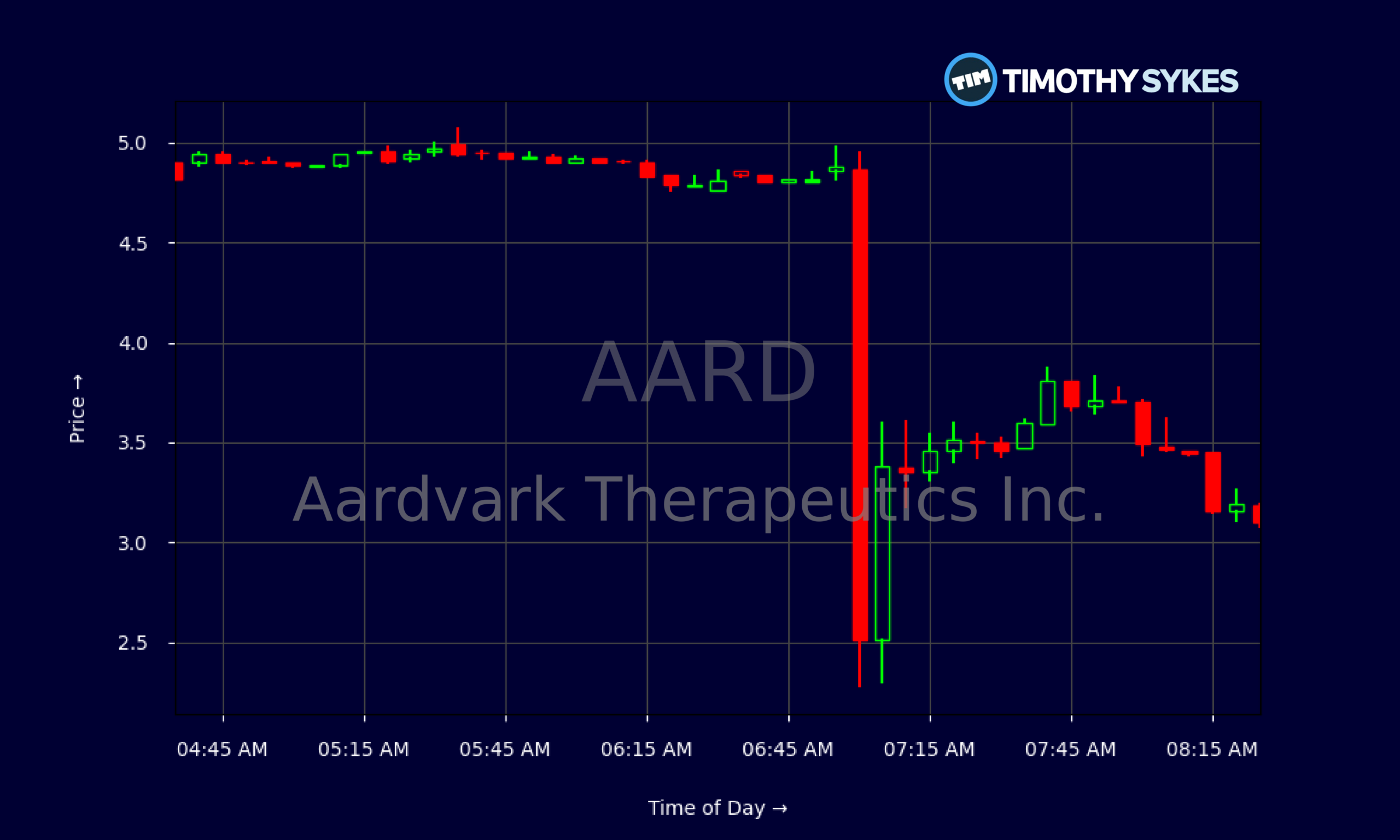
Over the last several sessions, AARD has gone from a 5.37 open on 2026/10/02 to a 3.95 close on 2026/10/22. Each bounce toward $4.50–$5 has been sold, signaling traders are fading strength rather than defending support. Intraday, today’s premarket 5‑minute tape shows extreme volatility: AARD traded near $4.90 around 05:30, then flushed to the $2s by 07:00 before grinding back into the low $3s. That’s a wild spread for any small-cap.
More Breaking News
Fundamentals show a typical early-stage biotech profile. AARD generated no reported revenue in the latest quarter and booked a net loss of about $14.39M, or roughly -$0.66 per share. Operating cash flow was about -$17.60M, but Aardvark still reported roughly $73.85M in cash and cash equivalents and a very light debt load. A current ratio above 12 suggests liquidity is not the near-term issue. For traders, that means the primary driver is not bankruptcy risk, but headline risk around ARD-101 and the FDA.
Why Traders Are Watching AARD Now
Aardvark Therapeutics is on every biotech day-trader’s radar because its whole story revolves around one high-stakes asset: ARD-101. Multiple class actions allege AARD overstated the safety profile and the clinical, regulatory, and commercial prospects of this drug. When traders see “materially misleading” tied to the lead candidate, they know sentiment is damaged, sometimes for years.
The timeline matters. Reports say Aardvark paused enrollment in its Phase 3 HERO trial, then the FDA escalated to a full clinical hold on ARD-101 after cardiac safety findings. A full FDA clinical hold is not a minor label tweak; it stops new and often ongoing dosing until regulators are satisfied. For AARD, whose pipeline is anchored by this obesity candidate, that is a direct hit to the core thesis.
Several law firms are now running securities class actions and governance investigations, all focused on whether Aardvark and AARD overstated ARD-101’s safety and commercial potential. One report notes a cumulative share price decline of more than 70% after the safety issues and hold surfaced. That kind of drawdown pulls in short-biased traders, momentum shorts, and bottom-fishers all at once.
In practice, this leaves AARD in a “headline casino” phase. Any update on ARD-101’s cardiac safety, any sign from the FDA about the full clinical hold, or any new filing in the securities case can spark abrupt moves. For disciplined traders, Aardvark Therapeutics becomes less about long-term drug success and more about reading the tape, respecting risk, and treating every spike as a trading setup, not a safety signal.
Conclusion
Aardvark Therapeutics and AARD are now defined by three linked problems: an FDA full clinical hold on ARD-101, securities class actions alleging misleading safety disclosures, and steep share price damage of more than 70%. The company still shows a sizable cash pile and minimal debt on its latest balance sheet, which buys time. But time alone does not repair trust. In biotech, a lead obesity drug under a full clinical hold is like a race car stuck in the pits while the laps keep counting.
For active traders, that mix means volatility and opportunity, but also danger. AARD’s intraday action — collapsing from the $4s into the $2s and then snapping back toward $3 — illustrates exactly why tight risk management is non‑negotiable here. The trend remains down, and bounces have been sold consistently since late 2026/09.
This content is for educational and research purposes only, but the trading lessons are clear. Focus on catalysts, not hope. Watch every FDA, trial, and courtroom headline tied to Aardvark Therapeutics and ARD-101, and size positions so one bad candle doesn’t end your month. As Tim Sykes likes to hammer home, “Cut losses quickly, always.” As millionaire penny stock trader and teacher Tim Sykes, says, “There is always another play around the corner; don’t chase just because you feel FOMO.”. In a name like AARD, that rule is not optional; it is survival.
This is stock news, not investment advice. Timothy Sykes News delivers real-time stock market news focused on key catalysts driving short-term price movements. Our content is tailored for active traders and investors seeking to capitalize on rapid price fluctuations, particularly in volatile sectors like penny stocks. Readers come to us for detailed coverage on earnings reports, mergers, FDA approvals, new contracts, and unusual trading volumes that can trigger significant short-term price action. Some users utilize our news to explain sudden stock movements, while others rely on it for diligent research into potential investment opportunities.
Dive deeper into the world of trading with Timothy Sykes, renowned for his expertise in penny stocks. Explore his top picks and discover the strategies that have propelled him to success with these articles:
- Penny Stocks Trading Guide
- Best Penny Stocks Under $1 to Buy Today
- Top 8 Penny Stocks to Watch on Robinhood
Once you’ve got some stocks on watch, elevate your trading game with StocksToTrade the ultimate platform for traders. With specialized tools for swing and day trading, StocksToTrade will guide you through the market’s twists and turns.
Dig into StocksToTrade’s watchlists here:





Leave a reply