

United States Antimony Corporation stocks have been trading up by 11.23 percent after investors reacted to its latest operational developments.
Key Takeaways Traders Are Watching
- Third-quarter deliveries of high-purity antimony ingots under a $245M sole-source U.S. Defense Logistics Agency contract are progressing, backed by new Bolivian feedstock and Stibnite Hill ore.
- Expanded foreign feedstock supply, a new Montana processing facility, and over 400,000 pounds of low-cost Stibnite Hill ore are expected to boost margins and shipment volumes for UAMY.
- Q3 updates reaffirm UAMY as the only producer of MIL-SPEC antimony ingots in the Western Hemisphere, underscoring its strategic role in U.S. defense supply chains.
- Texas Capital initiated UAMY with a Buy rating and a $9.50 price target, citing its status as the only operational antimony smelter in the U.S. and critical-minerals onshoring tailwinds.
- A new three-year contract with CEO Gary C. Evans locks in leadership through potential growth and any change-of-control events, though traders will watch how pay matches performance.
Live Update At 12:32:28 EDT: On Monday, October 19, 2026 United States Antimony Corporation stock [NYSE: UAMY] is trending up by 11.23%! Discover the key drivers behind this movement as well as our expert analysis in the detailed breakdown below.
Quick Financial Overview
United States Antimony Corporation, ticker UAMY, is trading like a classic high-expectation story. The daily chart shows a pullback from the mid-$4s in late 2026/09 toward a recent close near $3.17 on 2026/10/19. That is a sharp retrace of more than 25% from recent highs, even as bullish news stacks up.
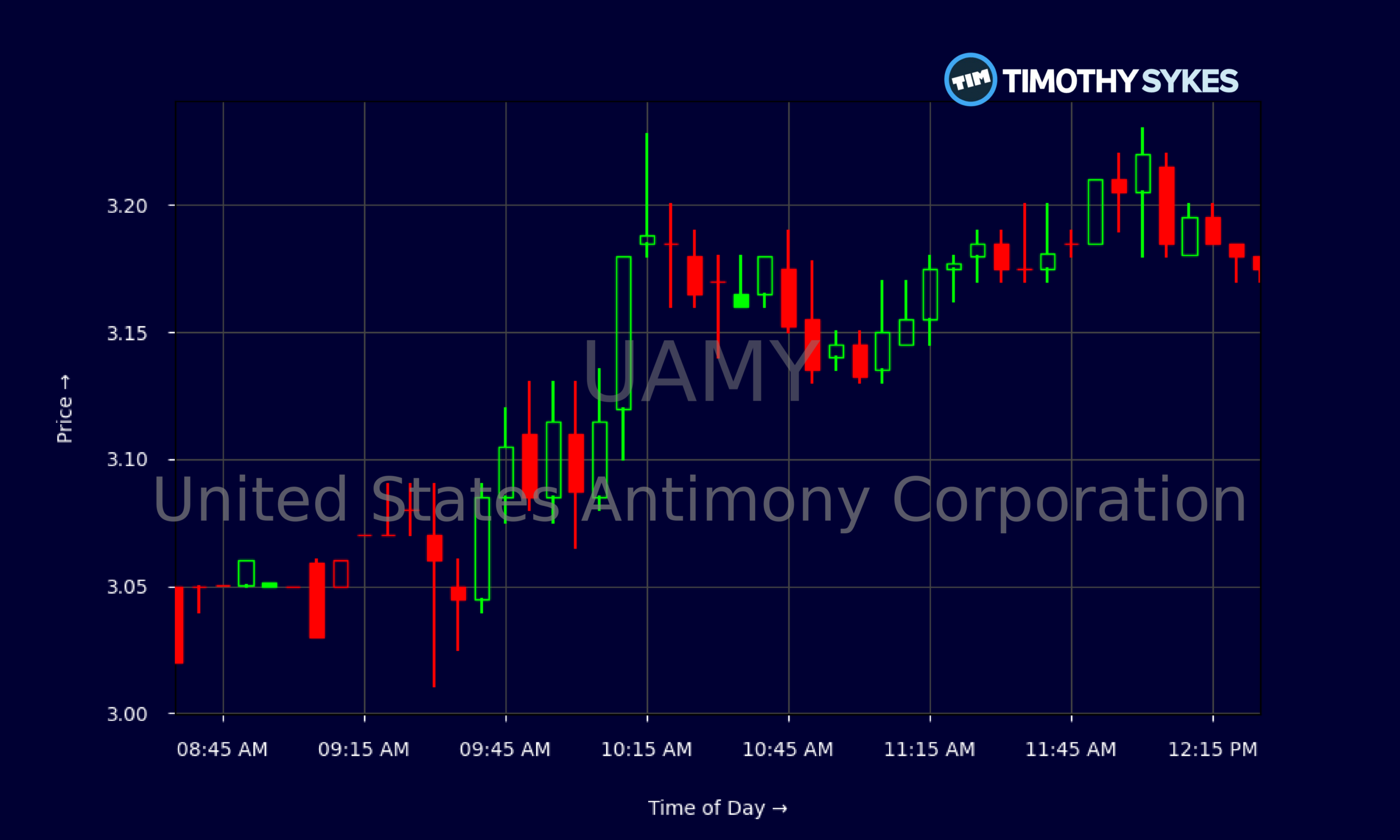
On the intraday 5‑minute chart, UAMY spent most of the latest session grinding between roughly $3.13 and $3.22. That tight range tells traders supply and demand are near balance for now. No blow-off top, no panic flush — just consolidation after a big run.
Fundamentals are still early-stage. UAMY booked about $39.3M in trailing revenue with roughly 63% growth over three years, but profitability is not here yet. EBIT margin sits deep in the red around -66%, and profit margin is about -45%. At the same time, the balance sheet is unusually strong for a small-cap resource name. With roughly $42.3M in cash, a current ratio near 11.5, and essentially no meaningful long-term debt, UAMY has room to execute.
More Breaking News
For active traders, that combination — heavy losses today, strong contract pipeline, and a cash-rich balance sheet — sets up a classic “story stock” backdrop where headlines can drive big swings.
Why Traders Are Locked In On UAMY Now
UAMY is in the middle of a rare setup: real government money, a strategic mineral, and a tight float narrative all colliding at once. The centerpiece is that $245M sole-source MIL‑SPEC contract with the U.S. Defense Logistics Agency. United States Antimony Corporation isn’t talking about a theoretical deal — it reports third-quarter deliveries of high-purity antimony ingots are already progressing.
For traders, that matters more than any pitch deck. Execution equals cash flow visibility. UAMY is backing those deliveries with two key levers: new Bolivian antimony feedstock and low-cost ore from its Stibnite Hill project in Montana. The company is stockpiling and processing over 400,000 pounds of material from Stibnite Hill, while ramping foreign feedstock and expanded capacity at a new Montana facility.
That combination points directly at margin improvement. Low-cost ore plus higher volumes under a fixed-price, sole-source contract means every step-up in efficiency can drop straight toward the bottom line over time. On top of that, UAMY reaffirmed that it is the only producer of MIL‑SPEC antimony ingots in the Western Hemisphere. In a world worried about supply chains and geopolitics, that kind of scarcity is a narrative traders love to trade around.
Texas Capital just put a spotlight on the story with a Buy rating and a $9.50 price target for UAMY. The call leans on UAMY’s status as the only operational antimony smelter in the U.S., broad North American mining claims, and the broader push to onshore critical minerals. Fresh analyst coverage with clear upside targets tends to pull new eyes onto the tape, often boosting volume as short‑term traders pile into any strong trend.
The new three-year contract with CEO Gary C. Evans adds another layer. A $430,000 base salary, bonus potential, and generous change-of-control severance tell traders that both the board and management are positioning UAMY for a multi-year growth push — and possibly future strategic interest. Governance details like this rarely move the stock on their own, but they shape how longer‑term traders read the risk–reward.
Conclusion
Right now, UAMY sits in that tension zone between fundamentals and expectations. On one side, the numbers show a company still losing money, with negative returns on assets and equity, and an EBITDA profile that would scare off conservative capital. On the other side, UAMY controls the only MIL‑SPEC antimony ingot production in the Western Hemisphere and holds a $245M sole-source defense contract backed by growing, lower‑cost feedstock.
The chart reflects that tug‑of‑war. UAMY pulled back hard from the $4s but is now stabilizing in the low $3s as traders digest the Q3 contract progress, Montana processing ramp, and Texas Capital’s $9.50 target. If the stock holds this consolidation and volume kicks up on positive contract or shipment updates, momentum traders will be watching for a squeeze back toward prior highs. If support cracks, the same crowd will step aside fast — this community cuts losses without hesitation.
For newer traders, UAMY is a real-time lesson in how story, supply/demand, and risk management collide. The fundamental story is strong, but the price already baked in a lot of hope. As Tim Sykes loves to say, “The market doesn’t reward what you believe, it rewards what you can prove on the chart and in the numbers.” That’s where disciplined trading psychology matters: As millionaire penny stock trader and teacher Tim Sykes, says, “The goal is not to win every trade but to protect your capital and keep moving forward.”. UAMY now has to keep proving it — one shipment, one earnings report, and one contract milestone at a time.
This analysis is for educational and research purposes only and is not investment advice.
This is stock news, not investment advice. Timothy Sykes News delivers real-time stock market news focused on key catalysts driving short-term price movements. Our content is tailored for active traders and investors seeking to capitalize on rapid price fluctuations, particularly in volatile sectors like penny stocks. Readers come to us for detailed coverage on earnings reports, mergers, FDA approvals, new contracts, and unusual trading volumes that can trigger significant short-term price action. Some users utilize our news to explain sudden stock movements, while others rely on it for diligent research into potential investment opportunities.
Dive deeper into the world of trading with Timothy Sykes, renowned for his expertise in penny stocks. Explore his top picks and discover the strategies that have propelled him to success with these articles:
- Penny Stocks Trading Guide
- Best Penny Stocks Under $1 to Buy Today
- Top 8 Penny Stocks to Watch on Robinhood
Once you’ve got some stocks on watch, elevate your trading game with StocksToTrade the ultimate platform for traders. With specialized tools for swing and day trading, StocksToTrade will guide you through the market’s twists and turns.
Dig into StocksToTrade’s watchlists here:





Leave a reply