

Palo Alto Networks Inc. stocks have been trading up by 7.63 percent amid upbeat analyst upgrades and strong cybersecurity demand.
What Traders Need To Know
- Unit 42 AI Defense and Prisma AIRS just landed on the OpenAI Marketplace, giving AI-focused enterprises low-friction access to Palo Alto Networks Inc. tools.
- Wells Fargo lifted its PANW price target to $525 and kept an Overweight view, signaling confidence in long-term cybersecurity budgets through 2027.
- Citigroup raised its target to $440 with a Buy rating, citing stronger security spending and AI-driven demand from recent CIO surveys.
- A sharp 7.6% pullback followed a broader tech rotation, reminding traders PANW trades as a high-beta AI and security name.
- Phillip Securities cut the stock to Reduce, highlighting stretched valuation after a strong rally despite solid fundamental tailwinds.
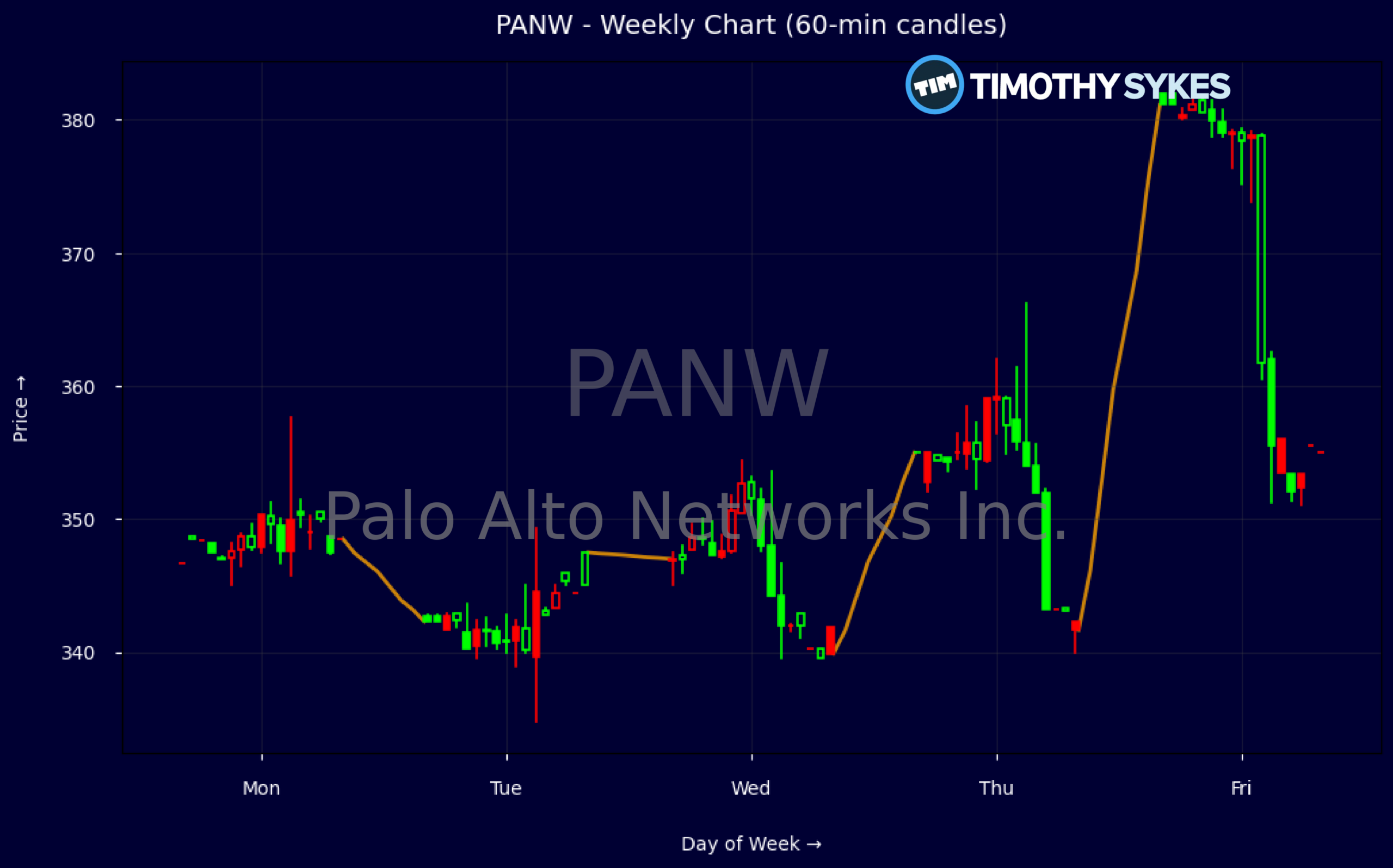
Weekly Update Oct 19 – Oct 23, 2026: On Sunday, October 25, 2026 Palo Alto Networks Inc. stock [NASDAQ: PANW] is trending up by 7.63%! Discover the key drivers behind this movement as well as our expert analysis in the detailed breakdown below.
Technology industry expert:
Analyst sentiment – positive
Palo Alto Networks sits in the top tier of global cybersecurity, with platform breadth and scale that smaller peers cannot match. Fundamentals show a high-quality, software-like model: 71.9% gross margin, EBIT margin of 13.2%, and low leverage (total debt-to-equity 0.07, interest coverage >20k). Revenue growth remains robust (≈18% 3-year CAGR, 22% over 5 years) and free cash flow is strong ($1.25B FCF vs. $1.36B OCF this quarter), but GAAP profitability lags due to heavy stock-based comp and AI/security R&D. Valuation is extreme versus software and security peers (P/E 343x, P/S 32x, P/FCF 109x, P/B 12.4x), embedding years of flawless execution and platform-share gains; return metrics (ROE 4.8% LTM, ROA 2.5%) remain below top-tier software benchmarks, highlighting multiple risk despite excellent strategic positioning.
Technically, PANW is in a powerful upside breakout on the weekly chart: a five-day staircase from $346.65 to $382 with higher highs and higher lows each session, terminating in a wide-range up bar ($380–382) that closed at the high, confirming aggressive demand. This move likely cleared significant overhead supply around $350–355, converting that band into first support. Intraday 5‑minute candles show persistent dip-buying and elevated volume into the close, consistent with institutional accumulation. Traders can anchor on $355 as a key pivot: above this level the dominant trend remains decisively bullish, with pullbacks to the $355–360 zone attractive for tactical long entries and stop placement just below $350.
Near term, catalysts are skewed favorably: multiple target hikes from Wells Fargo ($525) and Citi ($440) reflect strengthening CIO security budgets and AI-driven demand, while Unit 42 and Prisma AIRS distribution via the OpenAI Marketplace and the Anthropic CIDP partnership embed PANW inside strategic AI-security workflows. Sector tailwinds from the PHP vulnerability and potential PHP2Shell exploitation are material, driving incremental spend across endpoint, cloud, and incident response; PANW is structurally better positioned than the average Software & IT Services name due to its platform consolidation story and AI-native offerings. Offsetting this, a stretched valuation and recent insider Form 144 selling, plus a noted 7–8% pullback in a growth rotation, elevate drawdown risk. Relative to tech and software benchmarks, PANW trades at a premium that is justified only if it continues to outgrow and expand margins. My verdict: Positive but valuation-sensitive, with near-term support at $355 and stronger structural support near $340; upside fair value over 12–18 months is $440–$460, with $380 now acting as immediate resistance-turned-pivot.
More Breaking News
Quick Financial Overview
Palo Alto Networks Inc. sits at the center of two strong themes: AI security and structural cybersecurity spend. Recent weekly price action shows the stock breaking higher from the mid-$340s to close around the low-$380s, a decisive move that signals aggressive dip buying after prior volatility. Intraday, a session that opened in the mid-$350s and pushed toward $380+ in one wide candle reflects strong demand overwhelming supply once buyers stepped in.
On the fundamentals, PANW is running a high-margin, high-valuation model. Trailing gross margin near 71.9% and EBIT margin above 13% show a software-like profit profile on roughly $11.48B of revenue. Revenue growth in the high-teens to low-20% range over three to five years backs the premium, but a price-to-sales ratio over 32 and a P/E above 340 tell traders this is a momentum-driven, expectations-heavy name.
Cash flow and balance sheet quality help support that premium. The latest quarter shows about $1.36B in operating cash flow and $1.25B in free cash flow, even while GAAP net income is negative, driven in part by heavy stock-based compensation. Debt looks manageable with total debt-to-equity around 0.07 and strong interest coverage, though liquidity metrics like a current ratio just under 1 remind traders that PANW leans on recurring billings and deferred revenue rather than idle cash.
Conclusion
This is stock news, not investment advice. Timothy Sykes News delivers real-time stock market news focused on key catalysts driving short-term price movements. Our content is tailored for active traders and investors seeking to capitalize on rapid price fluctuations, particularly in volatile sectors like penny stocks. Readers come to us for detailed coverage on earnings reports, mergers, FDA approvals, new contracts, and unusual trading volumes that can trigger significant short-term price action. Some users utilize our news to explain sudden stock movements, while others rely on it for diligent research into potential investment opportunities.
Dive deeper into the world of trading with Timothy Sykes, renowned for his expertise in penny stocks. Explore his top picks and discover the strategies that have propelled him to success with these articles:
- Penny Stocks Trading Guide
- Best Penny Stocks Under $1 to Buy Today
- Top 8 Penny Stocks to Watch on Robinhood
Once you’ve got some stocks on watch, elevate your trading game with StocksToTrade the ultimate platform for traders. With specialized tools for swing and day trading, StocksToTrade will guide you through the market’s twists and turns.
Dig into StocksToTrade’s watchlists here:





Leave a reply