

Aehr Test Systems stocks have been trading up by 26.6 percent amid bullish sentiment on its semiconductor test demand outlook.
Key Takeaways Traders Need To Know
- Record Q1 FY27 revenue hit $33M, up 200% year over year and 75% sequentially, as demand for AI and power-semiconductor test and burn-in gear accelerated.
- Q1 EPS of $0.28 crushed the $0.13 consensus, with $33M revenue versus $27.53M, while $46.7M in bookings topped revenue by 40% and expanded backlog.
- Full-year FY27 revenue guidance was raised and tightened to a fixed $150M, triple FY26 and above the $137.79M Street view.
- Shares jumped about 16% in after-hours trading after the Q1 report, signaling strong enthusiasm for the outlook and profitability swing.
- Former Meta infrastructure VP Vijay Rao joined the Board, boosting AEHR’s AI data center and semiconductor infrastructure bench as it targets AI, data center, automotive, and industrial markets.
Live Update At 14:02:19 EST: On Tuesday, November 03, 2026 Aehr Test Systems stock [NASDAQ: AEHR] is trending up by 26.6%! Discover the key drivers behind this movement as well as our expert analysis in the detailed breakdown below.
Quick Financial Overview
AEHR has flipped the script. The company just posted Q1 FY27 revenue of $33M, tripling year over year and jumping 75% from the prior quarter, a level of acceleration traders rarely see in hardware test names. That growth pushed Aehr Test Systems back into strong profitability, with adjusted EPS at $0.28 versus just $0.01 a year ago and $0.13 expected by the Street.
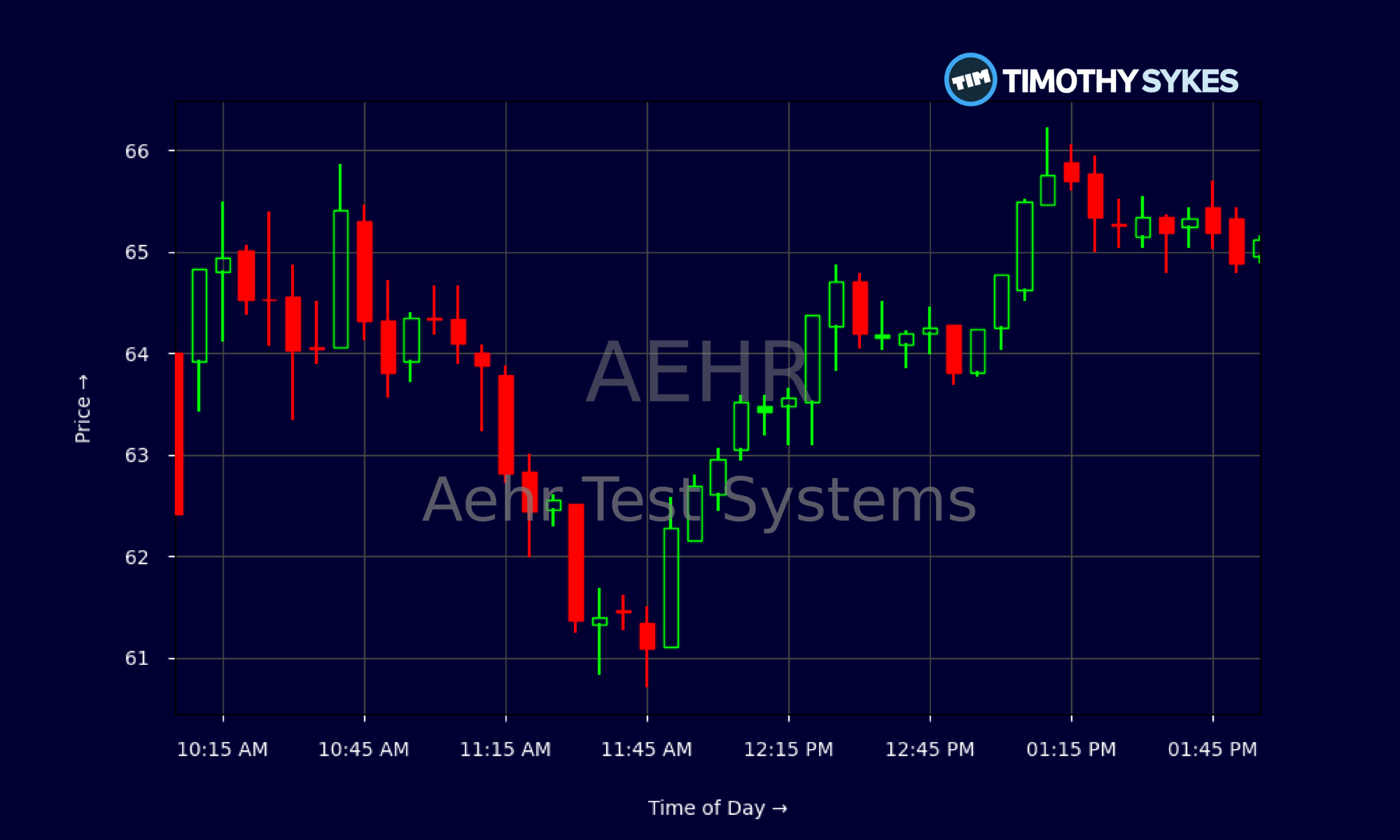
On the chart, AEHR has been volatile but trending higher. From 2026/10/09 through 2026/11/03, the stock swung from an intraday high near the low $90s down into the mid-$50s, then ripped back to a $65.15 close on 2026/11/03 as traders reacted to the numbers. That’s classic high-beta behavior around a catalyst.
More Breaking News
Intraday 5‑minute data shows steady accumulation after the initial spike, with AEHR holding gains above $64 for most of the session and grinding toward the high $60s. For active traders, that tells a clear story: strong hands are stepping in on dips, and the market is starting to price AEHR as a pure-play way to ride AI and power-semiconductor demand, despite premium valuation metrics like a rich price-to-sales ratio and high price-to-cash-flow levels.
Why Traders Are Watching AEHR After This Earnings Shock
AEHR is suddenly acting like a momentum leader again. The Q1 FY27 report wasn’t just “good” — it rewired expectations. Revenue at $33M was miles ahead of the prior year, booking growth was even stronger at $46.7M, and the backlog is now expanding faster than sales. For traders, that combination usually signals one thing: the demand wave is still building.
This surge is tied straight to the AI theme. Aehr Test Systems specializes in test and burn‑in systems for power semiconductors and AI-related chips. As hyperscale data centers and EV platforms demand higher reliability, long-duration stress testing moves from “nice to have” to “must have.” That’s where AEHR plugs in, and the numbers show customers are stepping up orders, not pulling back.
Management didn’t just beat the quarter and duck. They raised and locked FY27 revenue guidance at $150M, the top of the old $130M–$150M range and above the Street’s $137.79M. When a small-cap like AEHR stops giving a range and goes to a single, higher target, it signals real confidence in the order pipeline.
The 16% after-hours pop says many traders were caught leaning the wrong way. AEHR’s move from the low $50s to the mid‑$60s in one session is the kind of post-earnings reset that can attract breakout and momentum strategies — but it also raises the stakes. Chasing that type of gap without a plan is how traders get bagged, especially with valuation already stretched and historical margins still normalizing.
Layer in governance news, and the story gets more interesting. Adding former Meta VP of Infrastructure Vijay Rao to the Board ties AEHR closer to hyperscale AI data center circles. For longer‑term swing traders, that’s a subtle but real edge: board-level experience in building and scaling massive AI and cloud infrastructure can help Aehr Test Systems align its product roadmap with what big customers actually need.
Recent Form 4 filings show insider ownership is moving, but without details on size or direction, traders should treat that as background noise for now and watch future filings for clearer tells.
Conclusion
AEHR just delivered the kind of quarter momentum traders dream about: record revenue, a clean earnings beat, a sharply raised full-year guide, and a stock that ripped 16% in after-hours trading. The company is positioning itself as a picks‑and‑shovels player for AI and power semiconductors, and the $46.7M in bookings — well above recognized revenue — suggests this is not a one-off spike. The backlog and guidance at $150M, triple FY26, are the real anchors to the story.
At the same time, AEHR is not a “cheap” name. Valuation ratios like price-to-sales above 50 and lofty price-to-cash-flow multiples tell traders they are paying up for growth and execution. The balance sheet is strong — plenty of cash, minimal debt, high current and quick ratios — but profitability has only recently turned the corner, and historical margins have been choppy.
That’s where discipline matters. As Tim Sykes loves to hammer home, “Cut losses quickly, because big losers can come from anywhere, even the hottest sectors.” As millionaire penny stock trader and teacher Tim Sykes, says, “It’s not about how much money you make; it’s about how much money you keep.”. For AEHR, that means respecting your plan. The trend, the AI tie‑in, and the fundamentals all line up bullish right now, but the stock has already shown it can swing from the $90s to the $50s in weeks. Traders studying AEHR should focus on key levels, post‑gap consolidation, and the next bookings and backlog updates — not the hype. This article is for educational and research purposes only and is not investment advice.
This is stock news, not investment advice. Timothy Sykes News delivers real-time stock market news focused on key catalysts driving short-term price movements. Our content is tailored for active traders and investors seeking to capitalize on rapid price fluctuations, particularly in volatile sectors like penny stocks. Readers come to us for detailed coverage on earnings reports, mergers, FDA approvals, new contracts, and unusual trading volumes that can trigger significant short-term price action. Some users utilize our news to explain sudden stock movements, while others rely on it for diligent research into potential investment opportunities.
Dive deeper into the world of trading with Timothy Sykes, renowned for his expertise in penny stocks. Explore his top picks and discover the strategies that have propelled him to success with these articles:
- Penny Stocks Trading Guide
- Best Penny Stocks Under $1 to Buy Today
- Top 8 Penny Stocks to Watch on Robinhood
Once you’ve got some stocks on watch, elevate your trading game with StocksToTrade the ultimate platform for traders. With specialized tools for swing and day trading, StocksToTrade will guide you through the market’s twists and turns.
Dig into StocksToTrade’s watchlists here:





Leave a reply