

Zscaler Inc. stock has been trading up by 7.31 percent amid upbeat sentiment on strengthened cloud security demand.
What Traders Need To Know
- Wall Street banks sharply raised price targets on Zscaler Inc. (ZS) after its 2026 Investor Day, clustering in the $230–$275 range with Buy, Overweight, and Outperform ratings.
- Management at Zscaler Inc. outlined a roadmap to at least $8B in ARR by FY31, with several firms modeling an AI-driven upside case to $10B.
- Analysts from Wedbush and RBC highlighted mid-to-high-teens ARR growth with implied long-term operating margins near 27%–30%, supporting a profitable scale story.
- The company reaffirmed fiscal Q1 guidance, and the stock traded more than 4% higher, signaling market confidence in near-term execution.
- A new integration of Autonomous Application Shield with IBM and Red Hat’s Lightwell extends ZS deeper into application and AI-era security workflows.
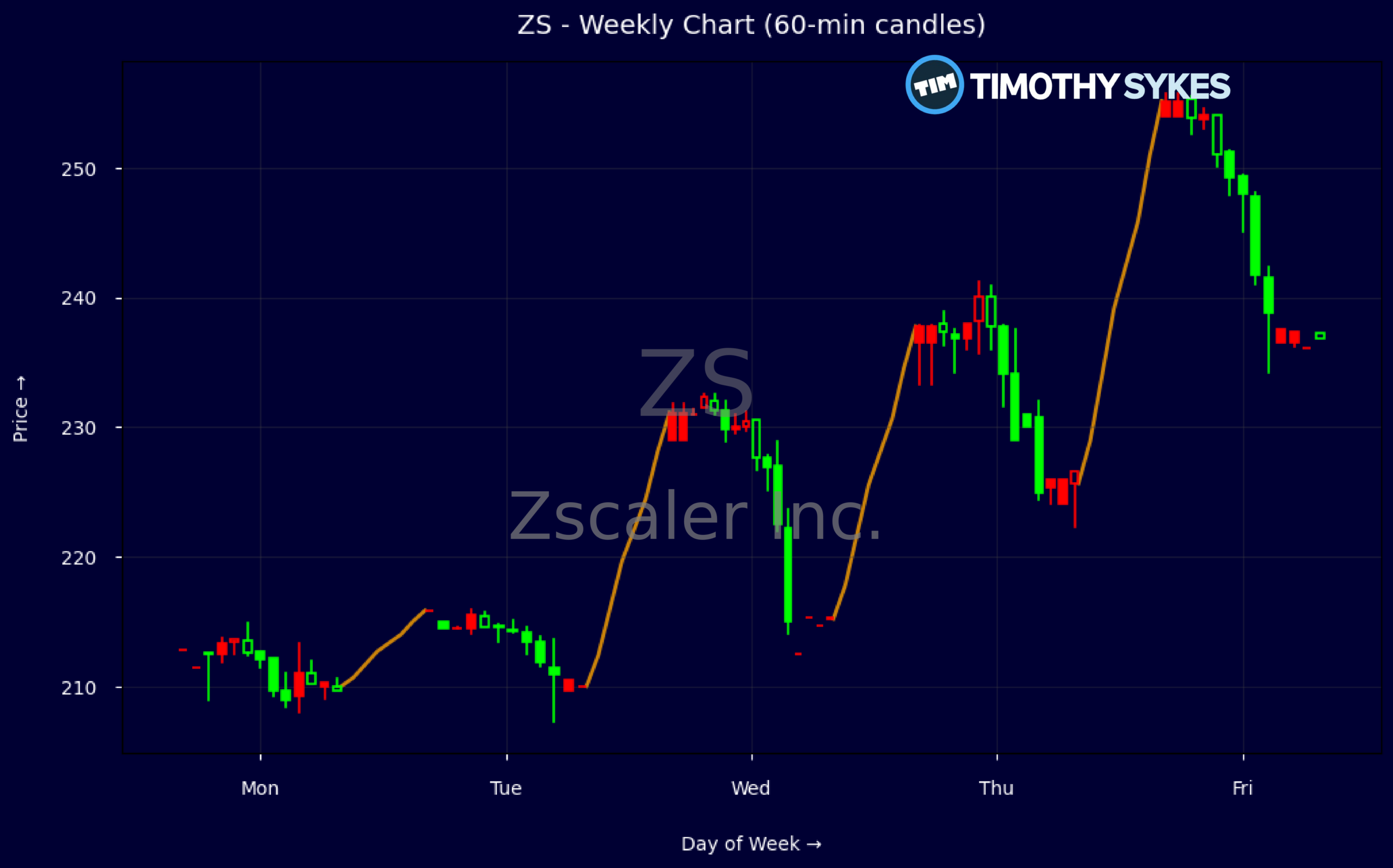
Weekly Update Oct 19 – Oct 23, 2026: On Friday, October 23, 2026 Zscaler Inc. stock [NASDAQ: ZS] is trending up by 7.31%! Discover the key drivers behind this movement as well as our expert analysis in the detailed breakdown below.
Technology industry expert:
Analyst sentiment – positive
Zscaler holds a leadership position in zero-trust cloud security, evidenced by 77% gross margins and ~28% three-year revenue CAGR on a $3.35B revenue base. Despite slightly negative GAAP margins (EBIT margin ~-0.4%, profit margin ~-1.9%) and weak accounting ROE, the business is structurally profitable: FCF is positive with ~$60M quarterly FCF and strong interest coverage (20x). A 11x sales, 34x cash-flow, and 160x FCF multiple embeds high growth but is reasonable versus premium cybersecurity peers.
Technically, ZS is in a strong weekly uptrend, with closes stair-stepping from ~$213 to ~$255 and successive higher highs and higher lows. Recent 5-minute action shows aggressive dip-buying and elevated volume on breakouts, confirming institutional accumulation. The key actionable level is $230–235, now major support; pullbacks into that zone offer favorable risk-reward. Near term, resistance is $260; a decisive, high-volume close above $260 would likely trigger momentum buying toward the high-$200s.
Recent news flow is uniformly bullish, with multiple Tier 1 brokers lifting targets into the $230–275 range and endorsing management’s $8–10B FY31 ARR framework and 27–30% long-term operating margin ambition. Zscaler is growing faster than the broader Technology and Software & IT Services benchmarks while already operating at peer-best gross margins and expanding FCF. With AI-driven security demand and IBM/Red Hat integrations as catalysts, I see a 12–18 month fair value range of $260–280, with strong support near $230.
More Breaking News
Quick Financial Overview
Zscaler Inc. sits at the center of two strong narratives right now: visible growth and rising AI-driven security demand. On the top line, ZS posted roughly $3.35B in revenue over the last year, with three- and five-year revenue growth rates near 28% and 38%. Gross margin around 76.8% shows a software-like profile, even though GAAP profit margins are still slightly negative, with an EBIT margin near -0.4% and net margin around -1.9%.
Cash flow tells a different story than earnings. Operating cash flow for the recent quarter reached about $279M, with free cash flow around $60.8M after heavy capital spending. That supports a rich valuation: price-to-sales near 11.4 and price-to-cash-flow around 34, plus an enterprise value near $37.1B. Balance sheet strength looks solid, with a current ratio of 1.7 and total debt-to-equity at 0.71, giving ZS room to keep investing in growth.
On the tape, ZS is in an uptrend. Weekly data show the stock pushing from the low $210s to about $254.8 over recent sessions, with a strong extension after Investor Day and guidance reaffirmation. Intraday, the 5‑minute chart is a steady grind higher, opening near the high $230s and closing the regular session around $255 before a small after-hours dip, suggesting persistent dip-buying and controlled profit-taking rather than wild volatility.
Conclusion
Zscaler Inc. is trading like a name with strong sponsorship and a clear story: AI security, high gross margins, and a credible path to multi‑billion‑dollar ARR. Multiple firms including Truist, Wells Fargo, Bank of America, Oppenheimer, RBC, UBS, Cantor Fitzgerald, Canaccord, TD Cowen, Wedbush, and Freedom Broker raised or reaffirmed bullish price targets in the $230–$275 band after the 2026 Investor Day. That wave of upgrades, plus reaffirmed Q1 and fiscal 2027 guidance, helps explain why the stock pushed more than 4% higher and now trades near recent highs.
For traders, the key tension is simple: ZS carries a premium multiple, but the Street is effectively saying the growth and margin runway can justify it. Revenue is compounding at high‑teens to high‑20s rates, gross margin is near 80%, and long‑term models point to 27%–30% operating margins if management executes. The recent IBM and Red Hat Lightwell integration, along with expanding AI security use cases, adds incremental fuel to that narrative without yet changing the financial base case.
From a trading standpoint, pullbacks toward prior breakout zones in the low-to-mid $230s may become battleground levels, while momentum traders will watch how ZS behaves around the cluster of raised targets in the mid‑$200s. Discipline and risk management matter more than the story alone; as millionaire penny stock trader and teacher Tim Sykes says, “Consistency is key in trading; don’t let emotions dictate your trades.” As I tell my students, “You do not get paid for believing the story; you get paid for timing the risk, so let the price action confirm the bullish narrative before you size up.” This article is for educational and research purposes only.
“,”scores”:{“risk-level”:”medium”},”trade”:”true
This is stock news, not investment advice. Timothy Sykes News delivers real-time stock market news focused on key catalysts driving short-term price movements. Our content is tailored for active traders and investors seeking to capitalize on rapid price fluctuations, particularly in volatile sectors like penny stocks. Readers come to us for detailed coverage on earnings reports, mergers, FDA approvals, new contracts, and unusual trading volumes that can trigger significant short-term price action. Some users utilize our news to explain sudden stock movements, while others rely on it for diligent research into potential investment opportunities.
Dive deeper into the world of trading with Timothy Sykes, renowned for his expertise in penny stocks. Explore his top picks and discover the strategies that have propelled him to success with these articles:
- Penny Stocks Trading Guide
- Best Penny Stocks Under $1 to Buy Today
- Top 8 Penny Stocks to Watch on Robinhood
Once you’ve got some stocks on watch, elevate your trading game with StocksToTrade the ultimate platform for traders. With specialized tools for swing and day trading, StocksToTrade will guide you through the market’s twists and turns.
Dig into StocksToTrade’s watchlists here:





Leave a reply