
OneConstruction Group Limited stocks have been trading up by 88.99 percent, driven mainly by strong infrastructure contract wins.
Key Trading Insights
- ONEG exploded from under $0.90 to an intraday high near $1.80, signaling aggressive speculative interest.
- Recent weekly action shows a sharp jump from a $0.78–$0.82 range to a close around $1.48, confirming a strong momentum push.
- Liquidity looks tight, with small equity and high leverage, meaning moves in OneConstruction Group Limited can be fast and extended.
- Revenue near $49.36M and a low price-to-sales ratio suggest traders are paying little for each dollar of sales.
- Chart volatility and thin balance-sheet cushion make risk management critical for short-term setups in ONEG.
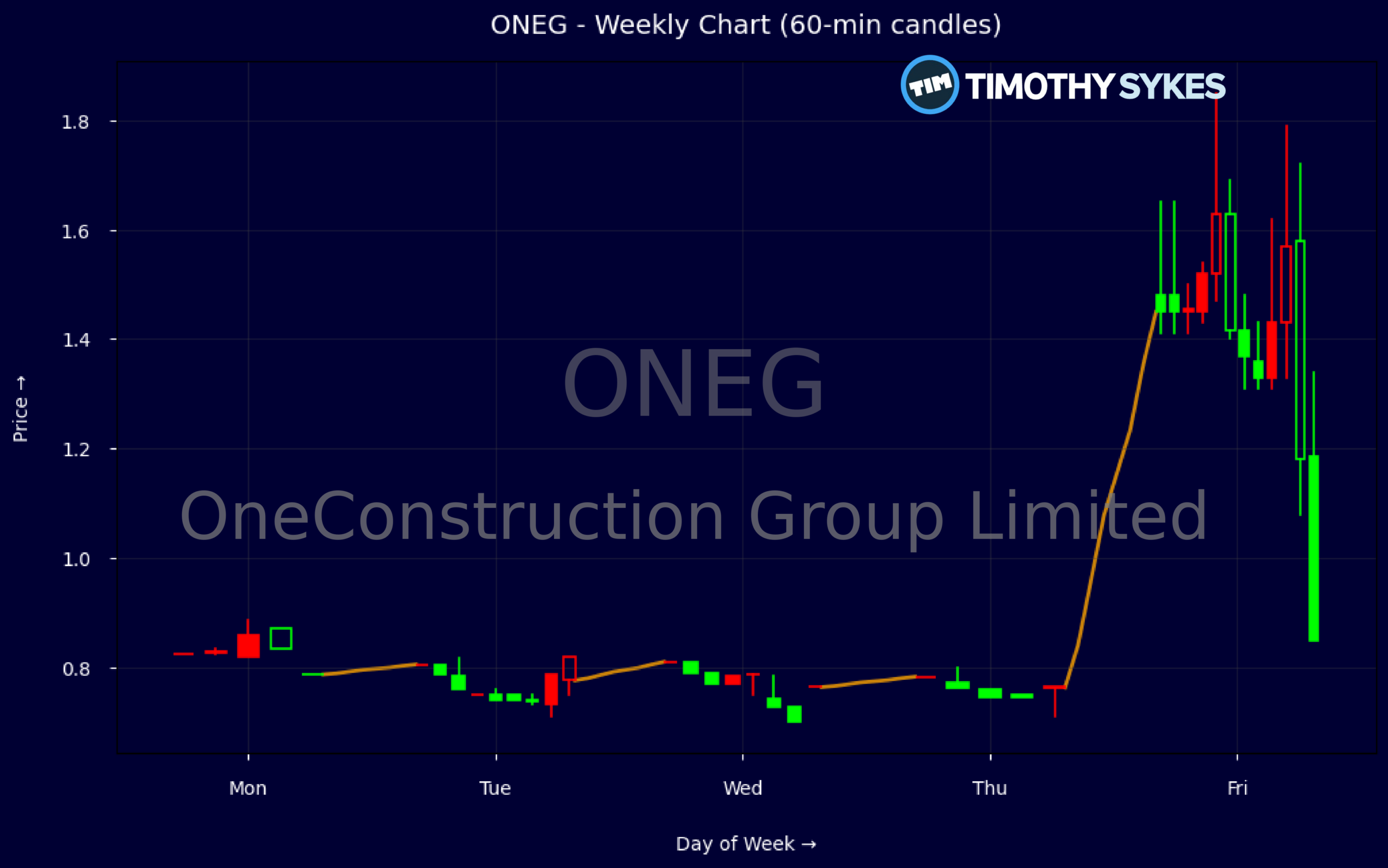
Weekly Update Oct 26 – Oct 30, 2026: On Sunday, November 01, 2026 OneConstruction Group Limited stock [NASDAQ: ONEG] is trending up by 88.99%! Discover the key drivers behind this movement as well as our expert analysis in the detailed breakdown below.
Industrials industry expert:
Analyst sentiment – negative
ONEG operates as a micro-cap industrials/construction name with distressed fundamentals and a highly levered balance sheet. Revenue of $49.4m versus enterprise value of ~$25.5m implies an undemanding 0.3x EV/sales and 1.31x P/B on a thin $0.76 BVPS, but equity is essentially residual with only $283k of common equity against $36.6m of liabilities. ROIC of 5.9% is modest, while a 4.1x leverage ratio and negative retained earnings signal elevated financial risk and limited margin for execution errors.
Technically, ONEG trades in an illiquid micro-cap regime with episodic price spikes. The weekly tape shows a tight sub-$0.85 range, then a single-session gap to $1.63 with a $1.85 high before closing $1.48, almost certainly on atypically high volume. That move breaks the prior consolidation and establishes a new resistance band at $1.80–1.85 and initial support near $0.80. Dominant trend is short-term bullish momentum from very low base; actionable level: buy only on pullback toward $1.05–1.10 with a hard stop below $0.80.
With no meaningful recent news, the move appears technical/speculative rather than fundamental. Versus broader Industrials and Construction benchmarks, ONEG is structurally weaker on balance sheet quality, profitability visibility, and scale, justifying a deep discount multiple. Near term, upside is capped by micro-cap liquidity and overhang from negative equity quality. Trading verdict: high-risk tactical vehicle only, not an investment; resistance $1.80–1.85, support $0.80, 3–6 month trading range target $0.90–1.40.
More Breaking News
Quick Financial Overview
OneConstruction Group Limited (ONEG) shows the kind of chart that gets momentum traders’ attention. Weekly data moved from a quiet band around $0.78–$0.82 to a breakout week opening near $1.63, spiking as high as $1.85, then closing around $1.48. Intraday, a single 5-minute bar captured a move from about $0.86 to $1.79 before settling near $1.63, a huge range for such a low-priced name.
Under the hood, revenue sits near $49.36M, with a price-to-sales ratio around 0.3. That means the market is valuing the company at only a fraction of its annual sales, which often attracts value-oriented swing traders alongside pure momentum players. Book value per share is about $0.76, with price-to-book around 1.31, so the stock is not extremely stretched relative to its stated equity base.
The balance sheet tells a more cautious story for ONEG. Total assets are about $36.90M, but total equity is only $0.28M, with retained earnings deeply negative. Total liabilities of roughly $36.62M and a leverage ratio around 4.1 show the company is heavily geared, which can amplify both upside and downside in the stock. Long-term debt is small versus capital on paper, but the thin equity cushion means traders should treat OneConstruction Group Limited as a higher-risk, higher-volatility name.
Conclusion
This is stock news, not investment advice. Timothy Sykes News delivers real-time stock market news focused on key catalysts driving short-term price movements. Our content is tailored for active traders and investors seeking to capitalize on rapid price fluctuations, particularly in volatile sectors like penny stocks. Readers come to us for detailed coverage on earnings reports, mergers, FDA approvals, new contracts, and unusual trading volumes that can trigger significant short-term price action. Some users utilize our news to explain sudden stock movements, while others rely on it for diligent research into potential investment opportunities.
Dive deeper into the world of trading with Timothy Sykes, renowned for his expertise in penny stocks. Explore his top picks and discover the strategies that have propelled him to success with these articles:
- Penny Stocks Trading Guide
- Best Penny Stocks Under $1 to Buy Today
- Top 8 Penny Stocks to Watch on Robinhood
Once you’ve got some stocks on watch, elevate your trading game with StocksToTrade the ultimate platform for traders. With specialized tools for swing and day trading, StocksToTrade will guide you through the market’s twists and turns.
Dig into StocksToTrade’s watchlists here:




Leave a reply