

Donnelley Financial Solutions Inc. stocks have been trading up by 9.6 percent following strong earnings and upbeat growth guidance.
What Traders Need To Know
- Q3 adjusted EPS of $1.07 beat the $0.84 consensus and last year’s $0.86, on $185M in net sales versus $179.9M expected, with EBITDA and margins moving higher.
- Software solutions grew about 5% year over year, with ActiveDisclosure up roughly 24%, and software now contributes about 51.5% of total net sales.
- Q4 net sales guidance of $175M–$180M topped the $170.9M consensus, with projected adjusted EBITDA margins of 26%–27% and about $50M in capital markets transactional net sales.
- Shares spiked roughly 12%–13% after the Q3 release, and Needham lifted its price target to $72 from $60, maintaining a Buy on strength in Tech-Enabled Solutions and ActiveDisclosure.
- A new Venue MCP Connector ties Microsoft Copilot and other AI tools directly into Venue data rooms, aiming to speed deal work while keeping tight governance and audit trails.
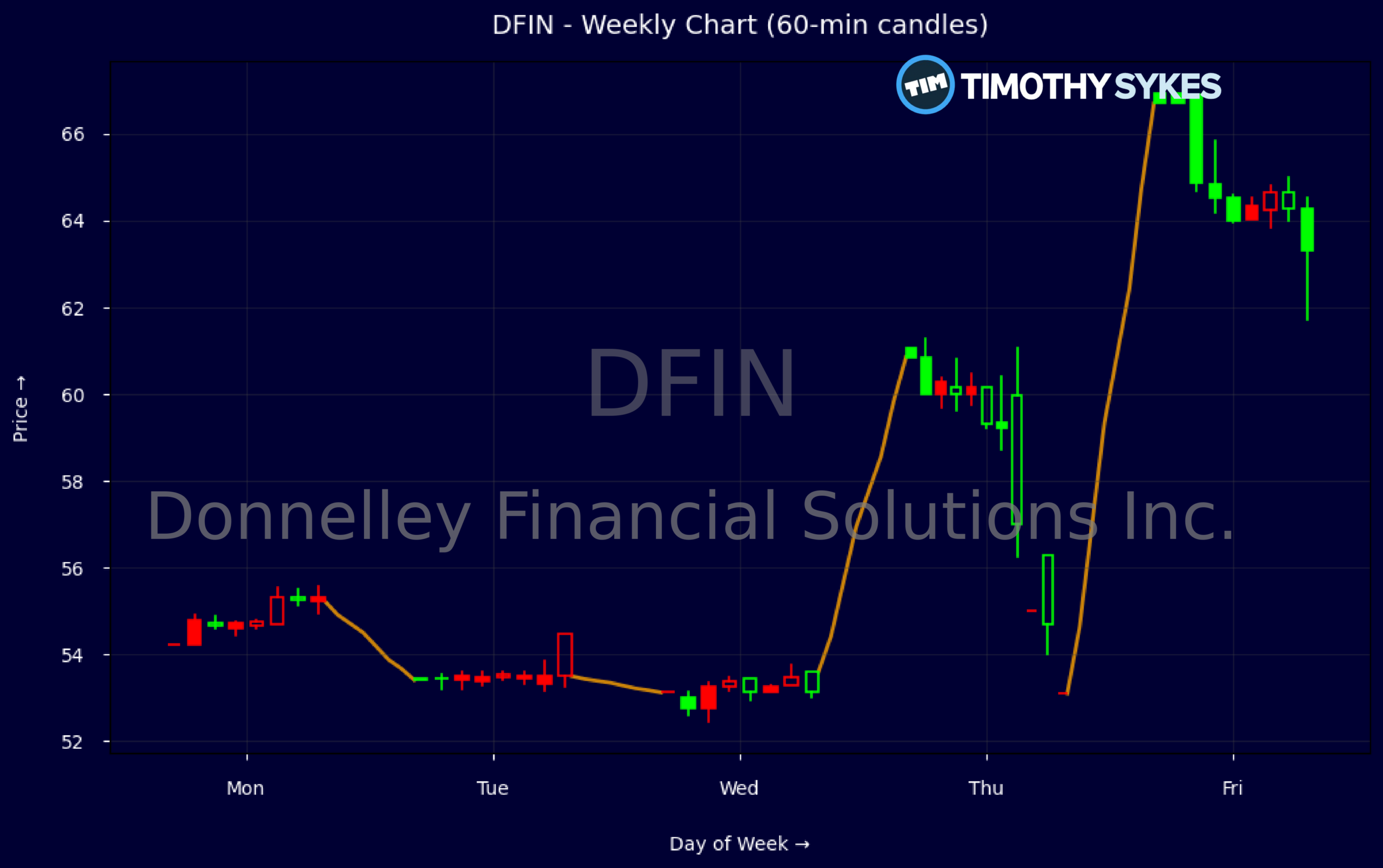
Weekly Update Oct 26 – Oct 30, 2026: On Saturday, October 31, 2026 Donnelley Financial Solutions Inc. stock [NYSE: DFIN] is trending up by 9.6%! Discover the key drivers behind this movement as well as our expert analysis in the detailed breakdown below.
Technology industry expert:
Analyst sentiment – positive
DFIN is transitioning into a higher-quality software-led filer/compliance platform with solid but not spectacular fundamentals. Gross margin of 64% and EBITDA margin of 16.7% reflect a structurally profitable model even with legacy print exposure, while EBIT margin of 8.1% leaves room for mix-driven upside. ROE of 22.6% and ROA of 10.1% are strong versus peers, supported by disciplined capital returns (buybacks) and manageable leverage (0.55x D/E, 9.7x interest coverage). Free cash flow of $85.8M on $98.2M operating cash underpins a low ~5x P/FCF multiple versus a richer 31.7x P/E, indicating earnings are temporarily depressed by amortization and non-cash items. Revenue CAGR remains slightly negative over 3–5 years, but recent quarterly 5.5% growth and software at 51.5% of net sales show the pivot is gaining traction.
The stock’s technical profile has pivoted sharply bullish, with a powerful post-earnings breakout from the low-$50s base: prices jumped from ~$53 to nearly $67 in a few sessions, with consecutive high closes and no meaningful intraday retracement, signaling aggressive institutional demand. Five‑minute candles show sustained buying pressure and elevated volume through the $60–63 zone, now key short-term support. The actionable level is $60: above it, trend-followers can stay long or initiate on pullbacks; a decisive break below $60 would signal exhaustion of the breakout and likely mean reversion toward the mid‑$50s.
Recent beats on revenue and EPS, above-consensus Q4 guidance, and a Needham target hike to $72 confirm DFIN is executing ahead of the broader Tech and Software & IT Services group, where many names face decelerating growth and multiple compression. With adjusted EBITDA margins guided to 26–27% and new AI-enabled products like Venue MCP Connector strengthening the differentiated compliance stack, DFIN warrants a valuation closer to high-teens EV/EBITDA software hybrids. I see near-term resistance around $70–72 and support at $60–62, with a 6–12 month target of $72, implying further upside as software mix and transactional capital markets volumes scale.
More Breaking News
Quick Financial Overview
Donnelley Financial Solutions Inc. (DFIN) just put up the kind of quarter that forces the market to re-price. Q3 revenue landed at $185M, a clear beat on the roughly $179.9M expectation, with adjusted EPS of $1.07 versus a $0.84 consensus and $0.86 a year ago. That combination of top-line growth and margin expansion is what powers trend shifts, and traders saw it quickly in the tape.
Under the hood, DFIN is leaning harder into software. Software solutions net sales were up about 5% year over year, with roughly 24% growth in ActiveDisclosure and software now at around 51.5% of total net sales. Given a gross margin of 64.2% and EBITDA margin near 16.7%, this mix shift toward tech-enabled, recurring revenue helps explain why the market is willing to accept a P/E near 31.7 and a price-to-sales around 1.5.
The balance sheet is solid enough to support this strategy. Debt-to-equity sits at roughly 0.55, interest coverage is about 9.7, and operating cash flow of $98.2M against capital spending of $12.4M in the latest quarter produces strong free cash flow. On the chart, weekly prices show DFIN breaking from the low $50s to close near $66.93 after the report, while the intraday candle with a $63.30 open and $66.89 close confirms aggressive buying and a strong momentum push.
Conclusion
This is stock news, not investment advice. Timothy Sykes News delivers real-time stock market news focused on key catalysts driving short-term price movements. Our content is tailored for active traders and investors seeking to capitalize on rapid price fluctuations, particularly in volatile sectors like penny stocks. Readers come to us for detailed coverage on earnings reports, mergers, FDA approvals, new contracts, and unusual trading volumes that can trigger significant short-term price action. Some users utilize our news to explain sudden stock movements, while others rely on it for diligent research into potential investment opportunities.
Dive deeper into the world of trading with Timothy Sykes, renowned for his expertise in penny stocks. Explore his top picks and discover the strategies that have propelled him to success with these articles:
- Penny Stocks Trading Guide
- Best Penny Stocks Under $1 to Buy Today
- Top 8 Penny Stocks to Watch on Robinhood
Once you’ve got some stocks on watch, elevate your trading game with StocksToTrade the ultimate platform for traders. With specialized tools for swing and day trading, StocksToTrade will guide you through the market’s twists and turns.
Dig into StocksToTrade’s watchlists here:





Leave a reply