

APA Corporation stocks have been trading up by 4.15 percent after upbeat analyst upgrades signaled improving earnings and production prospects.
What Traders Need To Know
- RBC expects APA to deliver better‑than‑consensus Q3 earnings and cash flow, helped by strong commodity pricing, slightly higher production, and slightly lower capex, while keeping a Sector Perform rating and $47 target.
- UBS lifted its APA target to $52 from $47, still Neutral, seeing Q3 EBITDA above consensus, stable production, and rising exploration spend in Alaska, Suriname, and Uruguay.
- Multiple firms, including Wells Fargo, Truist, Jefferies, UBS, Roth Capital, and Scotiabank, now cluster APA price targets roughly in the $41–$52 band, while the stock trades near the high‑$40s on a Hold/Sector Perform consensus.
- Recent supplemental Q3 2026 metrics show strong realized commodity prices, trading gains on oil and gas, modest dry hole costs, and active buybacks, offset by higher G&A from stock‑based pay.
- RBC expects broadly flat production from 2026 to 2027 while capex steps up to fund exploration with TotalEnergies in Alaska, Suriname, and Uruguay, pointing to a pivot toward longer‑term growth.
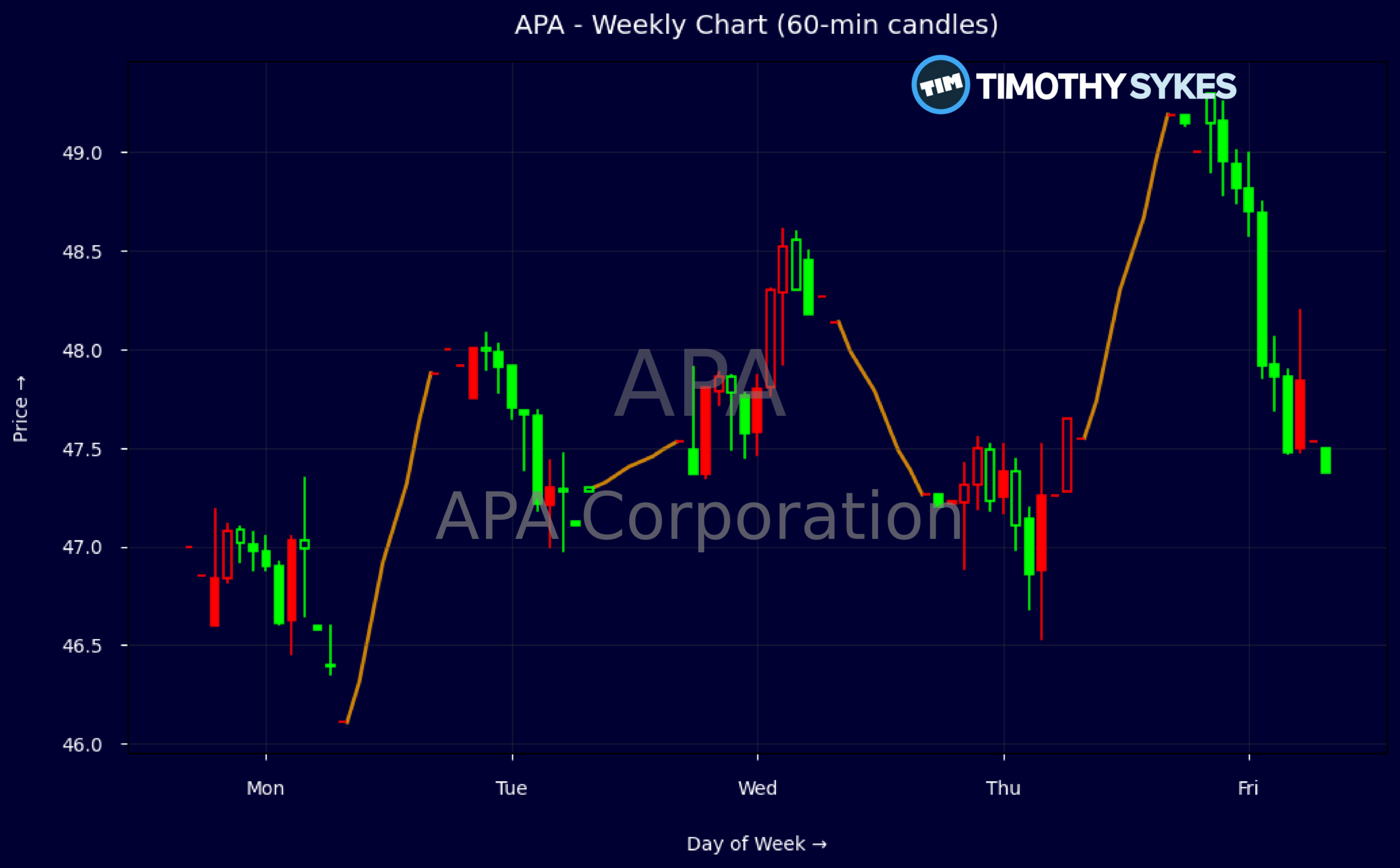
Weekly Update Oct 12 – Oct 16, 2026: On Saturday, October 17, 2026 APA Corporation stock [NASDAQ: APA] is trending up by 4.15%! Discover the key drivers behind this movement as well as our expert analysis in the detailed breakdown below.
Energy industry expert:
Analyst sentiment – positive
APA operates as a high-margin, free-cash-flow-rich mid-cap E&P with unusually strong profitability metrics (EBIT margin ~105%, ROE ~26% LTM, ROIC ~15%) and disciplined leverage (D/E ~0.5x, interest coverage ~14x). Despite a multi‑year revenue decline, current cash generation is robust: Q2 operating cash flow was ~$1.7B against capex of ~$0.6B, yielding FCF of ~$1.1B and a FCF multiple of ~3–4x. Working capital is slightly negative, but liquidity is adequate and supports a sustainable dividend plus buybacks.
Technically, APA is in a short-term uptrend, with closes rising from ~$47.0 to ~$49.2 this week and a strong Friday range expansion day confirming buyer control. Five-minute candles show persistent dip-buying near $48.80–$49.00 with higher lows, suggesting institutions are adding on intraday weakness. Key actionable level is support at ~$47.50, which aligns with mid-week consolidation; as long as price holds above that on normal volume, the bias favors a retest and breakout through the $50 psychological level.
Recent news flow is uniformly constructive: multiple houses have lifted price targets into the low‑$50s, with consensus “Hold” but upside skew driven by Suriname and broader exploration optionality. Relative to Energy and Fossil Fuel benchmarks, APA offers higher FCF yield and more exploration torque but somewhat higher execution risk. With oil near $100, disciplined capex, and a 60% FCF return framework, fair value sits at $50–$52 over 6–12 months, with support at $47 and resistance at $52.
More Breaking News
Quick Financial Overview
APA Corporation is trading in the high‑$40s, with recent weekly closes clustering between about $47 and $49. After a brief dip, the stock pushed to the $49 area, and a recent 5‑minute candle shows a strong intraday move from the high‑$47s to over $49. This aligns with a 7.1% jump on 2026/10/16 as crude futures surged, confirming that APA is tightly linked to oil price spikes and can re‑rate quickly when the sector catches a bid.
On the fundamentals, APA generated roughly $8.92B in revenue over the last year, with very strong reported margins, including high double‑digit profit measures. The P/E near 9.7 and price‑to‑cash‑flow around 2.4 point to a market that is still pricing APA like a cyclical energy name, not a high‑growth story. At the same time, leverage looks manageable with total debt‑to‑equity around 0.53 and interest coverage above 14, backed by $1.71B in quarterly operating cash flow and about $1.14B in free cash flow.
For traders, APA’s capital return and growth mix stands out. Management is on track to return 60% of annual free cash flow, including an annual dividend rate of $1, roughly a 2% yield at current prices, plus sizable buybacks hinted at near $575–$600M in Q4. RBC and UBS both expect Q3 earnings and EBITDA above consensus, while Street targets have drifted up into the low‑$50s, with Roth Capital and UBS at $52. The catch is that most ratings remain Hold or Sector Perform, and revenue has shrunk meaningfully over three years, so the market still treats APA as a disciplined cash machine rather than a pure growth vehicle.
Conclusion
This is stock news, not investment advice. Timothy Sykes News delivers real-time stock market news focused on key catalysts driving short-term price movements. Our content is tailored for active traders and investors seeking to capitalize on rapid price fluctuations, particularly in volatile sectors like penny stocks. Readers come to us for detailed coverage on earnings reports, mergers, FDA approvals, new contracts, and unusual trading volumes that can trigger significant short-term price action. Some users utilize our news to explain sudden stock movements, while others rely on it for diligent research into potential investment opportunities.
Dive deeper into the world of trading with Timothy Sykes, renowned for his expertise in penny stocks. Explore his top picks and discover the strategies that have propelled him to success with these articles:
- Penny Stocks Trading Guide
- Best Penny Stocks Under $1 to Buy Today
- Top 8 Penny Stocks to Watch on Robinhood
Once you’ve got some stocks on watch, elevate your trading game with StocksToTrade the ultimate platform for traders. With specialized tools for swing and day trading, StocksToTrade will guide you through the market’s twists and turns.
Dig into StocksToTrade’s watchlists here:





Leave a reply