

Inter & Co. Inc. stocks have been trading up by 7.57 percent following upbeat earnings and strong digital growth momentum.
What Traders Need To Know
- JPMorgan raised Inter & Co.’s price target from $9 to $11 and reaffirmed an Overweight rating after a Brazil “risk-on” rally, driven by lower cost of equity and higher earnings estimates.
- UBS lifted its price target on Inter & Co. to $10 from $8.80 and reiterated a Buy rating, signaling confidence in further upside potential.
- The stock trades around $7.21 versus a mean Street target of $10.20 and carries an overall Overweight stance from analysts, pointing to a notable perceived upside gap.
- Management named Alexandre Riccio as COO and executive vice chair and Francisco Santos as Chief Growth Officer, adding Brazil-focused leadership while shares dipped 1.8% pre-market on the announcement.
- A recent Form 6-K filing with the SEC was routine for INTR as a foreign private issuer, with no new operational or strategic details.
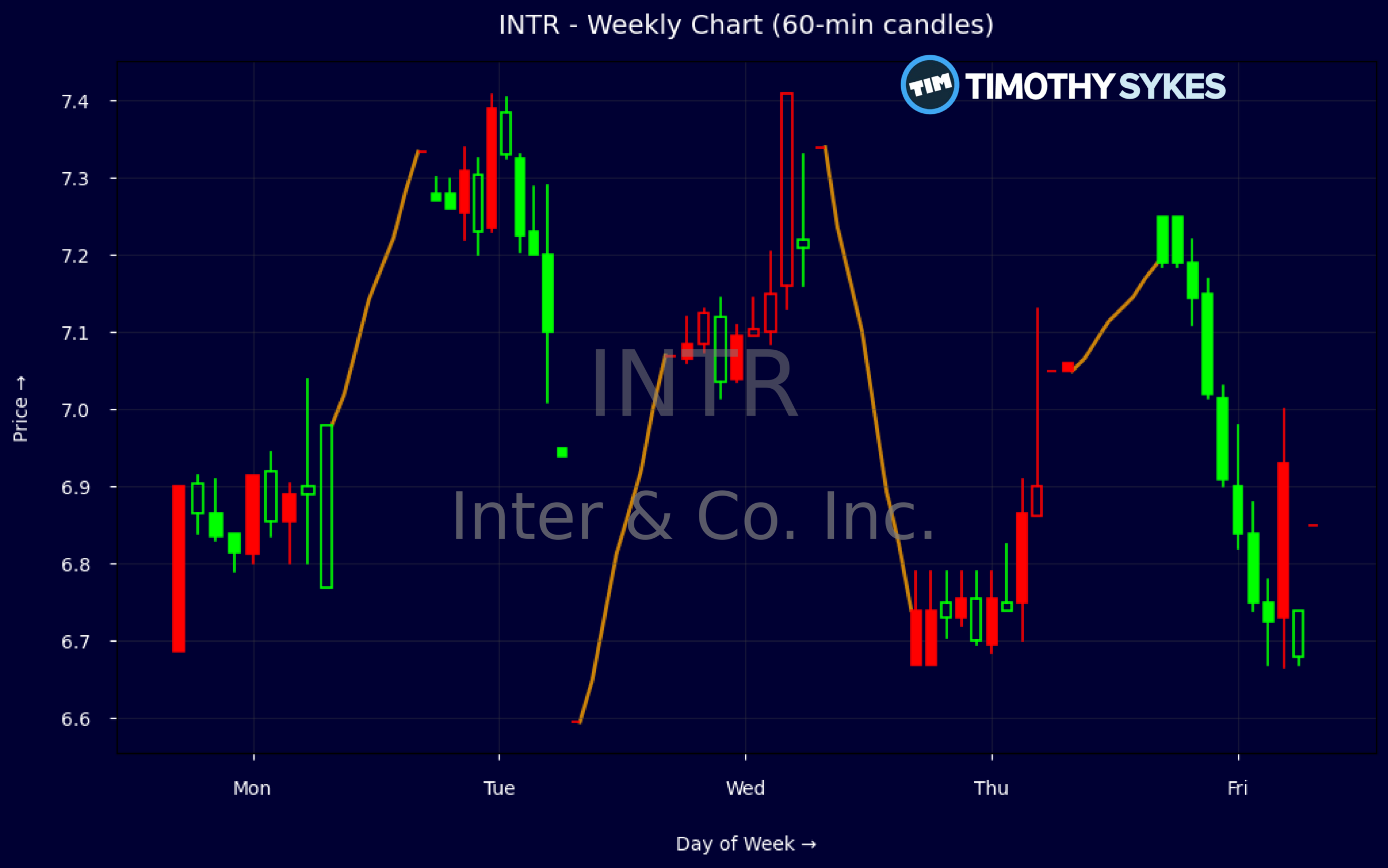
Weekly Update Oct 19 – Oct 23, 2026: On Friday, October 23, 2026 Inter & Co. Inc. stock [NASDAQ: INTR] is trending up by 7.57%! Discover the key drivers behind this movement as well as our expert analysis in the detailed breakdown below.
Finance industry expert:
Analyst sentiment – positive
Inter&Co (INTR) is a fast-growing Brazilian digital bank with $8.4B in revenue but still operating with a negative pre-tax margin of -2.3%, indicating scale but incomplete profitability. Balance sheet leverage (ratio 9.7x) is high but typical for banks, with equity of ~$10.2B against ~$98.6B in assets and a solid liquidity buffer ($11.7B cash and equivalents). ROE of 8% and ROA of 1% are improving but below top-tier Brazilian banking peers, justifying only a mid-teens valuation rerating, not a full premium.
Technically, INTR is in a short-term uptrend, with weekly closes stepping higher from 6.69 to 7.33 and then 7.25, confirming buyers in control after a base around 6.70. Intraday 5-minute action (not shown numerically but implied by recent closes) suggests active dip-buying near 7.00 with supply emerging around 7.30–7.35. Dominant trend is bullish above 7.00; a specific actionable level is a buy zone at 7.00–7.05 with a tight stop below 6.80, targeting a first upside test at 7.80–8.00.
Fundamental and sentiment catalysts are clearly supportive: JPMorgan and UBS have both raised price targets to $10–11 and reaffirmed Buy/Overweight, while the stock trades around $7.2 versus a ~$10.2 Street mean, implying ~40% upside. Management upgrades (new COO and CGO) reinforce the growth agenda. Relative to Brazilian financials, INTR commands a higher P/S (2.07x) but offers above-sector growth. I set a 12-month target range of $9.50–10.50, with support at 6.70 and resistance at 8.00 then 10.00.
More Breaking News
Quick Financial Overview
Inter & Co. Inc. (INTR) is trading at a discount to consensus targets, with UBS citing a $7.21 spot price against roughly $10.20 as the Street mean. On the weekly tape, the stock has pushed from the mid-$6.60s to about $7.25, showing a clear short-term uptrend and higher weekly close. That move lines up with the cluster of bullish analyst calls, which often act as fuel for follow-through buying when price confirms.
Intraday, the 5-minute chart shows a steady grind higher from the $6.80–$6.90 zone into the low $7s, with shallow pullbacks and quick dips being bought. This is classic controlled accumulation rather than a one-and-done spike. Closing near the high of the day around $7.25 signals buyers stayed in charge into the close, a constructive sign for momentum traders watching INTR for next-day continuation.
Fundamentally, Inter & Co. Inc. posted about $8.40B in revenue with a price-to-sales near 2.07 and price-to-book around 1.71, suggesting the market is not paying extreme multiples for the growth story. Profitability is still thin, with a pretax margin of about -2.3% and return on equity around 8%, while leverage is high with a 9.7 ratio typical of a bank-driven balance sheet. Dividend yield near 1.68% is modest but signals some capital return while the company scales.
Conclusion
Inter & Co. Inc. sits in an interesting spot where price action, analyst support, and corporate moves are lining up. Two global heavyweights, JPMorgan and UBS, have recently raised price targets into the $10–$11 range while keeping positive ratings, creating a clear reference band above current levels for traders. The weekly and intraday charts confirm that buyers have stepped in around the high-$6 area and pushed price into the low-$7s with strength into the close.
Management changes, with new COO and Chief Growth Officer roles filled by Brazil-centric operators, add an execution angle that markets will be quick to judge through future earnings and growth metrics. At the same time, thin margins and a leveraged balance sheet remind traders that this is still a developing story, not a finished blue-chip bank. For short-term traders, the key questions are whether INTR can hold above recent support near $6.80–$7.00 and build a base toward the analyst target zone.
From here, traders should treat Inter & Co. Inc. as a developing momentum-and-repricing setup, not a blind buy. As I tell my students, “You do not trade the hype, you trade the levels, the volume, and the catalyst — when all three line up, that is when you press your edge.” As millionaire penny stock trader and teacher Tim Sykes, says, “Embrace the journey, the ups and downs; each mistake is a lesson to improve your strategy.” This stock now has all three in play, making it a name to track closely for educational and research purposes.
This is stock news, not investment advice. Timothy Sykes News delivers real-time stock market news focused on key catalysts driving short-term price movements. Our content is tailored for active traders and investors seeking to capitalize on rapid price fluctuations, particularly in volatile sectors like penny stocks. Readers come to us for detailed coverage on earnings reports, mergers, FDA approvals, new contracts, and unusual trading volumes that can trigger significant short-term price action. Some users utilize our news to explain sudden stock movements, while others rely on it for diligent research into potential investment opportunities.
Dive deeper into the world of trading with Timothy Sykes, renowned for his expertise in penny stocks. Explore his top picks and discover the strategies that have propelled him to success with these articles:
- Penny Stocks Trading Guide
- Best Penny Stocks Under $1 to Buy Today
- Top 8 Penny Stocks to Watch on Robinhood
Once you’ve got some stocks on watch, elevate your trading game with StocksToTrade the ultimate platform for traders. With specialized tools for swing and day trading, StocksToTrade will guide you through the market’s twists and turns.
Dig into StocksToTrade’s watchlists here:





Leave a reply