

GoDaddy Inc. stocks have been trading up by 10.72 percent amid strong investor optimism driven by its latest strategic developments.
What Traders Need To Know
- Q3 2026 results for GDDY topped EPS and revenue expectations, and GoDaddy Inc. raised full-year 2026 revenue guidance toward the high end of its $5.215B–$5.255B range.
- AI product Airo is scaling fast, with one analyst noting its annualized run rate has more than doubled to above $100M, positioning it as a key growth engine into Q4.
- Street reaction has been constructive, with UBS lifting its price target to $112 and Evercore ISI to $105, keeping ratings measured but acknowledging execution.
- Latest 2026 revenue outlook of $5.22B–$5.26B sits around prior consensus near $5.24B, underscoring steady topline growth rather than a hyper-growth story.
- A pending shareholder investigation over past discounting tactics adds legal and sentiment risk that could inject volatility despite strong fundamentals.
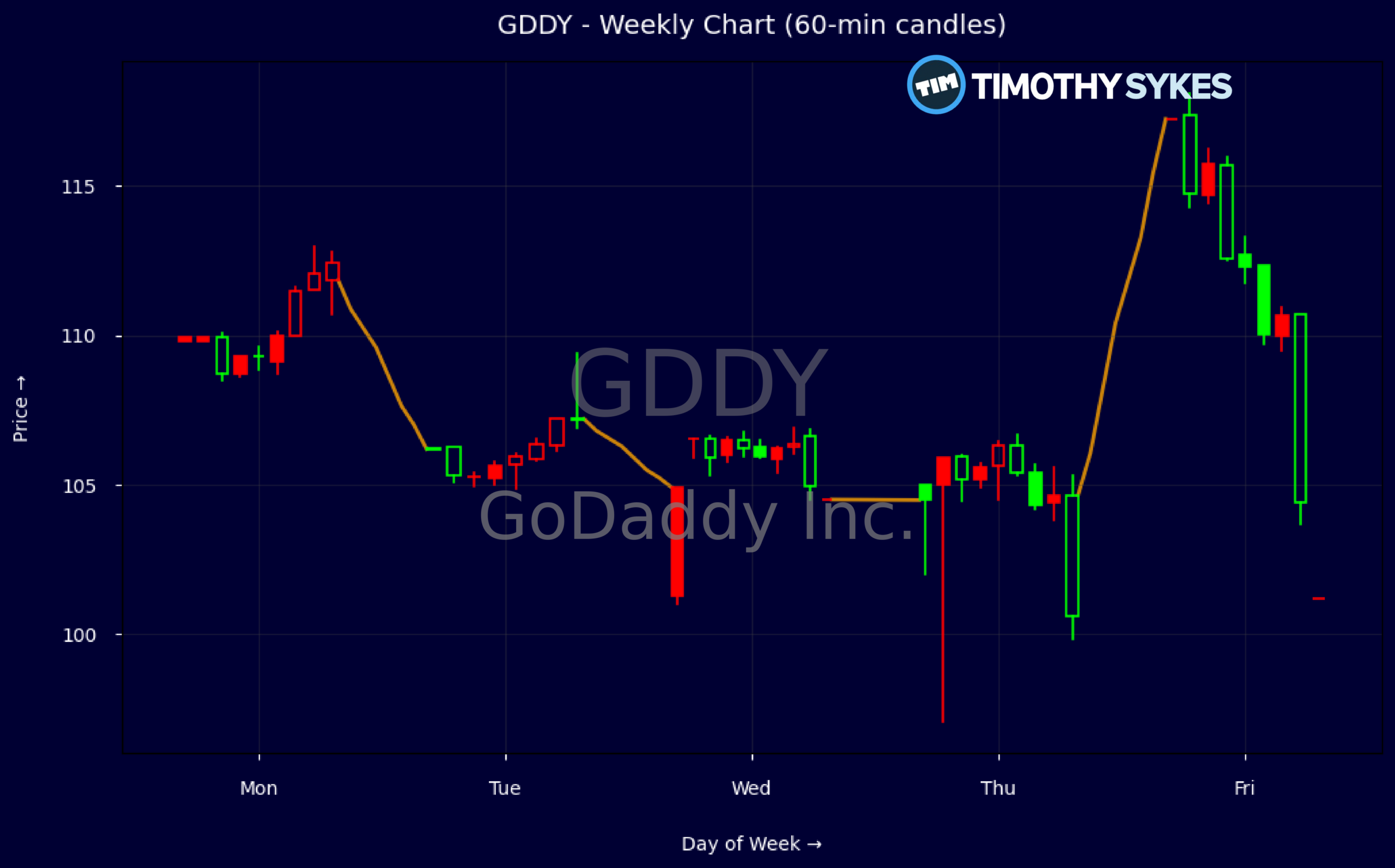
Weekly Update Oct 26 – Oct 30, 2026: On Saturday, October 31, 2026 GoDaddy Inc. stock [NYSE: GDDY] is trending up by 10.72%! Discover the key drivers behind this movement as well as our expert analysis in the detailed breakdown below.
Technology industry expert:
Analyst sentiment – positive
GoDaddy sits in a structurally advantaged niche as an SMB domain, hosting, and web-presence platform with high-quality fundamentals. Gross margin above 80% and EBIT margin near 26% are top-quartile versus Software & IT Services peers, while FCF conversion is strong at ~7x price-to-FCF and robust ROIC in the low‑20s. The balance sheet is highly leveraged (debt/equity >500%, negative book value), but interest coverage around 9x and over $1.1B of cash keep risk manageable. Aggressive buybacks (nearly $0.5B this quarter) are meaningfully shrinking the float and amplifying per-share earnings power.
Technically, GDDY is in a strong uptrend, with the weekly tape showing a sharp post‑earnings breakout from the low‑100s to $117.24 on 10/30, likely on elevated volume versus prior weeks. Intraday 5‑minute action confirms buyers absorbing supply above $105 with shallow pullbacks and higher lows. The dominant trend is bullish, and $105 is now the key actionable level: it should act as primary support and a high‑probability add-on zone, while near‑term resistance sits around the recent $117–118 spike high.
Recent catalysts are decisively favorable: Q3 beat on EPS and revenue, raised full‑year guidance to the high end, and accelerating Airo AI adoption with >$100M ARR run‑rate, driving bookings upside. Street targets have been raised into the $105–$112 range and the stock now trades near the upper end of that band, broadly in line with sector multiples despite superior margins and FCF profile. Governance overhang from the customer-strategy investigation is manageable. I see justified upside to $120–$125 over 6–12 months, with strong support at $105 and secondary support near $100.
More Breaking News
Quick Financial Overview
GoDaddy Inc. (GDDY) just delivered the type of print traders look for: Q3 EPS and revenue ahead of expectations and full-year 2026 revenue guidance nudged toward the high end of its $5.215B–$5.255B range. That move effectively takes earlier in-line guidance of $5.22B–$5.26B and leans it slightly above the roughly $5.24B consensus, signaling confidence in the run-rate. With total revenue around $4.95B and three- to five-year growth in the 7% range, this is a steady compounding profile.
Profitability is the real story under the hood. GDDY is running with about 82% gross margin and EBIT margin near 26%, translating to strong operating leverage. Return on capital above 20% and robust free cash flow — roughly $475.8M this quarter alone — give the company room to keep buying back stock, as shown by over $480.6M in repurchases, while still funding product and AI initiatives. The trade-off is high leverage, with debt-to-equity above 500% and a thin current ratio of 0.6, so this remains a cash-flow-and-execution story, not a fortress balance sheet.
Valuation sits in the middle of the road. A P/E around 15.5 and price-to-sales near 2.6 are not stretched for a high-margin software-like business, but price-to-book is meaningless here given negative equity and heavy intangibles. The tape confirms renewed momentum: after trading near $101 earlier in the week, GDDY ripped intraday from about $103.7 to $118.11 before closing around $117.24, a powerful earnings breakout. Weekly closes now cluster around $106–$117, showing strong demand absorption after the news.
Conclusion
This is stock news, not investment advice. Timothy Sykes News delivers real-time stock market news focused on key catalysts driving short-term price movements. Our content is tailored for active traders and investors seeking to capitalize on rapid price fluctuations, particularly in volatile sectors like penny stocks. Readers come to us for detailed coverage on earnings reports, mergers, FDA approvals, new contracts, and unusual trading volumes that can trigger significant short-term price action. Some users utilize our news to explain sudden stock movements, while others rely on it for diligent research into potential investment opportunities.
Dive deeper into the world of trading with Timothy Sykes, renowned for his expertise in penny stocks. Explore his top picks and discover the strategies that have propelled him to success with these articles:
- Penny Stocks Trading Guide
- Best Penny Stocks Under $1 to Buy Today
- Top 8 Penny Stocks to Watch on Robinhood
Once you’ve got some stocks on watch, elevate your trading game with StocksToTrade the ultimate platform for traders. With specialized tools for swing and day trading, StocksToTrade will guide you through the market’s twists and turns.
Dig into StocksToTrade’s watchlists here:





Leave a reply