timothy sykes logo

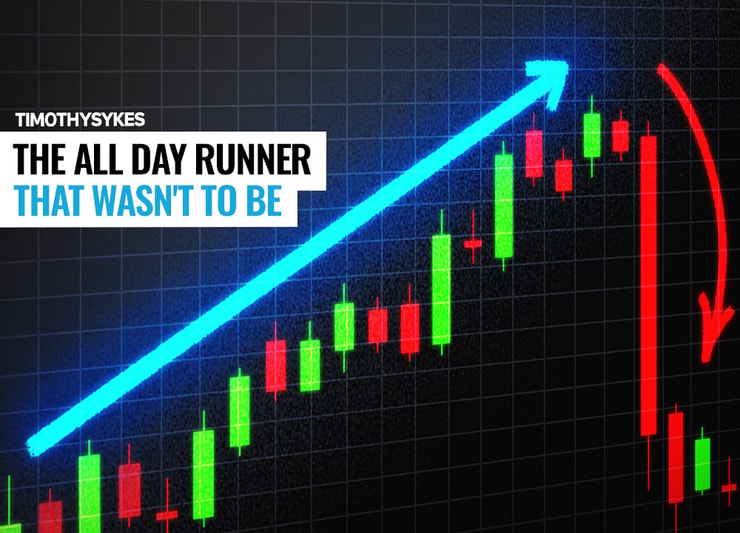
The All Day Runner That Wasn’t To Be

Timothy SykesAvatar
Written by Timothy Sykes
Updated 10/21/2026 5 min read

My job is never done.

There will ALWAYS be over-aggressive, degenerate gamblers who refuse to trade scared.

That is…

Until they lose enough that it hurts.

The crazy thing is, that’s when most people quit.

They think, “I’m not good at trading. Trading sucks. I’m giving up.”

That’s sad because the reality is, they’ve just not been properly taught.

So, right when they should be MORE focused on the process…

They want to walk away.

This is EXACTLY why I teach…

You Should ALWAYS Trade Scared

Yesterday, there was yet another example.

Alpha Modus Holdings Inc. (NASDAQ: AMOD) looked like an all day runner.

AMOD 10/21/26 premarket to 1:30 p.m. ET

I was congratulating longs who traded it better than me.

Then the company did an offering and it cracked (hard).

After it happened, everyone was talking about how it was completely unpredictable.

Again, my job is never done…

No, It Was NOT “Completely Unpredictable”

Everyone on X doing introspective “shoulda, coulda, woulda” posts was plain wrong.

To anyone who was surprised by the AMOD drop, you might want to focus more on preparation.

Stocks like AMOD have been tanking after offerings for decades.

This is NOT new or unpredictable…

AMOD 10/21/26 1-min candles, BIG crack on offering

Did I know there was going to be an offering?

No. Of course not.

But my timestamped sell alert an hour before the big drop was pretty clear:

(I’m in the Azores, 4 hours ahead, which is why the timestamp says 5:12 p.m.)

Check out my exact wording, because it’s a telltale sign of what was to come:

“…every penny higher here is such a grind, that usually precedes a big drop…”

NOW do you see…

Why I Always Trade Cowardly
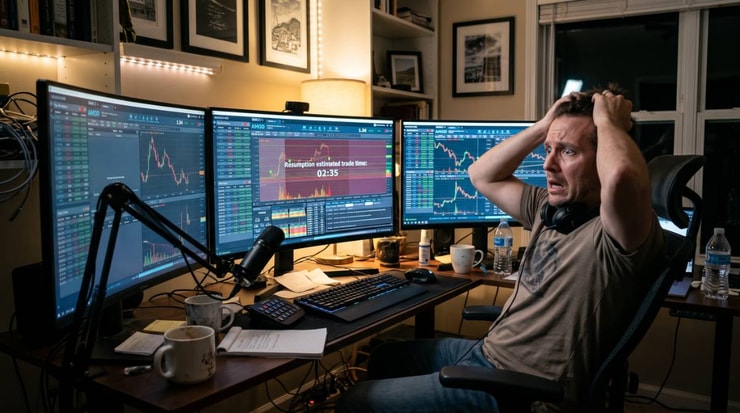
Image created with Google Gemini

Nobody wants to get stuck in a halt after an offering. It’s scary, because you have no idea how far it could drop.

But as long as you…

  • Trade small
  • Sell into strength
  • And NEVER believe the hype…

You don’t EVER have to end up pulling our hair out while you wait to see how much you’ve lost.

Here’s the reality…

You can be a VERY successful trader without taking huge risks.

But guess what?

You MUST Focus On the Process and Study, Study, Study
Post image

Get my after-hours watchlist, free

The Night Tape, every trading day after the closing bell, plus The Second Session guide.

Image created with Google Gemini

The reason why 90% of trades lose is because 90% of traders are unprepared for these events.

Not everyone, but most.

Yes, I even had some students get stuck in AMOD. Needless to say, I assigned them 100 burpees and told them to study.

And I’m sure they’ll learn because they hear me say it almost every day.

If you trade scared, trading isn’t scary.

Now let’s move on to something fun.

I’ve teamed up with top trader Lance Ippolito after he shared a new strategy with me.

You can learn more about it here:

Discover a brand new way to target 100%+ returns in the first hour of the trading day.

Also, we’re giving away thousands in free prizes, but you have to unlock the video to get step-by-step instructions on how to enter the free giveaway.

Key Takeaway

I’ve seen stocks like AMOD drop like a knife after an offering again and again.

If you trade long enough, you’ll probably get caught in one.

But you NEVER have to put yourself in a bad position by trading too big.

Remember, 99.99% of these companies fail. They’re terrible companies.

But they DO give you an opportunity to grow a small account.

Have a great day and STUDY HARD!

Cheers,

– Tim Sykes


How much has this post helped you?


Leave a reply

Author card Timothy Sykes picture

Timothy Sykes

Tim Sykes is a penny stock trader and teacher who became a self-made millionaire by the age of 22 by trading $12,415 of bar mitzvah money. After becoming disenchanted with the hedge fund world, he established the Tim Sykes Trading Challenge to teach aspiring traders how to follow his trading strategies. He’s been featured in a variety of media outlets including CNN, Larry King, Steve Harvey, Forbes, Men’s Journal, and more. He’s also an active philanthropist and environmental activist, a co-founder of Karmagawa, and has donated millions of dollars to charity.
Read More

* Results are not typical and will vary from person to person. Making money trading stocks takes time, dedication, and hard work. There are inherent risks involved with investing in the stock market, including the loss of your investment. Past performance in the market is not indicative of future results. Any investment is at your own risk. See Terms of Service here

The available research on day trading suggests that most active traders lose money. Fees and overtrading are major contributors to these losses.

A 2000 study called “Trading is Hazardous to Your Wealth: The Common Stock Investment Performance of Individual Investors” evaluated 66,465 U.S. households that held stocks from 1991 to 1996. The households that traded most averaged an 11.4% annual return during a period where the overall market gained 17.9%. These lower returns were attributed to overconfidence.

A 2014 paper (revised 2019) titled “Learning Fast or Slow?” analyzed the complete transaction history of the Taiwan Stock Exchange between 1992 and 2006. It looked at the ongoing performance of day traders in this sample, and found that 97% of day traders can expect to lose money from trading, and more than 90% of all day trading volume can be traced to investors who predictably lose money. Additionally, it tied the behavior of gamblers and drivers who get more speeding tickets to overtrading, and cited studies showing that legalized gambling has an inverse effect on trading volume.

A 2019 research study (revised 2020) called “Day Trading for a Living?” observed 19,646 Brazilian futures contract traders who started day trading from 2013 to 2015, and recorded two years of their trading activity. The study authors found that 97% of traders with more than 300 days actively trading lost money, and only 1.1% earned more than the Brazilian minimum wage ($16 USD per day). They hypothesized that the greater returns shown in previous studies did not differentiate between frequent day traders and those who traded rarely, and that more frequent trading activity decreases the chance of profitability.

These studies show the wide variance of the available data on day trading profitability. One thing that seems clear from the research is that most day traders lose money .

Millionaire Media 66 W Flagler St. Ste. 900 Miami, FL 33130 United States (888) 878-3621 This is for information purposes only as Millionaire Media LLC nor Timothy Sykes is registered as a securities broker-dealer or an investment adviser. No information herein is intended as securities brokerage, investment, tax, accounting or legal advice, as an offer or solicitation of an offer to sell or buy, or as an endorsement, recommendation or sponsorship of any company, security or fund. Millionaire Media LLC and Timothy Sykes cannot and does not assess, verify or guarantee the adequacy, accuracy or completeness of any information, the suitability or profitability of any particular investment, or the potential value of any investment or informational source. The reader bears responsibility for his/her own investment research and decisions, should seek the advice of a qualified securities professional before making any investment, and investigate and fully understand any and all risks before investing. Millionaire Media LLC and Timothy Sykes in no way warrants the solvency, financial condition, or investment advisability of any of the securities mentioned in communications or websites. In addition, Millionaire Media LLC and Timothy Sykes accepts no liability whatsoever for any direct or consequential loss arising from any use of this information. This information is not intended to be used as the sole basis of any investment decision, nor should it be construed as advice designed to meet the investment needs of any particular investor. Past performance is not necessarily indicative of future returns.

Citations for Disclaimer

Barber, Brad M. and Odean, Terrance, Trading is Hazardous to Your Wealth: The Common Stock Investment Performance of Individual Investors. Available at SSRN: “Day Trading for a Living?”

Barber, Brad M. and Lee, Yi-Tsung and Liu, Yu-Jane and Odean, Terrance and Zhang, Ke, Learning Fast or Slow? (May 28, 2019). Forthcoming: Review of Asset Pricing Studies, Available at SSRN: “https://ssrn.com/abstract=2535636”

Chague, Fernando and De-Losso, Rodrigo and Giovannetti, Bruno, Day Trading for a Living? (June 11, 2020). Available at SSRN: “https://ssrn.com/abstract=3423101”